

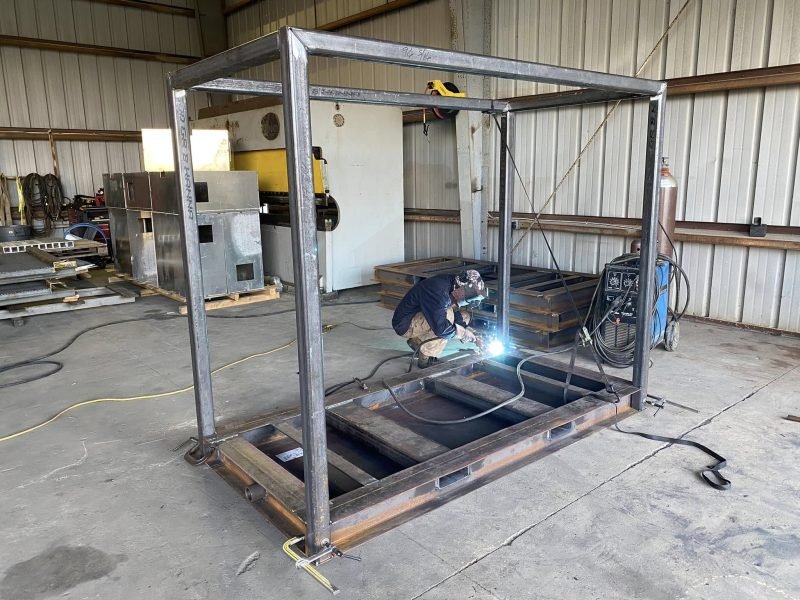
The short list
Every fabrication quote is built from the same handful of facts. A shop estimates material by the size, thickness and quantity, estimates labor by the number of cuts, bends, welds and finishing steps, and adds anything special like delivery or on-site work. If one of those facts is missing, the shop either guesses, pads the price to cover the guess, or stops and asks. None of those is as good as having the answer up front.
Here is what to gather before you send the quote form:
- A sketch, drawing or file that shows the shape.
- Overall dimensions and the critical ones that have to be exact.
- Material and thickness, or a description of what it will do so the shop can choose.
- Quantity, now and later.
- Finish: bare, painted, powder coated, brushed, polished.
- Photos of the site, the old part, or the thing it attaches to.
- The deadline, and whether it is firm.
- Whether you will pick up, need delivery, or need it installed on site.
You will not have all of these on every job, and that is fine. A quote for a driveway gate starts differently from a quote for twenty plate brackets. The rest of this guide covers each item and why it changes the number.
A sketch or drawing, even a rough one
The single most useful thing you can send is a picture of the shape with numbers on it. It does not have to be pretty. A pencil sketch on graph paper, photographed with your phone, tells a fabricator more than three paragraphs of description. Draw the part from the front and from the side, mark the overall length, width and height, and mark the size and location of any holes, cutouts, tabs or bends.
If you have a formal drawing from an engineer or a designer, send it as it is. If you have a product photo from a catalog or a picture of something similar you saw somewhere, send that too, with a note on what you would change. Fabricators are used to turning a reference photo into a drawing; they just need to know which features matter to you and which were only in the photo by accident.
What a shop does with a sketch
The shop turns your sketch into a shop drawing or a cut file, checks that the dimensions close (a surprising number of sketches do not add up), works out how it will be cut, bent and welded, and often comes back with one or two suggested changes that make the part cheaper or stronger. That back and forth is normal. A clear first sketch keeps it to one round.
Dimensions: overall size and the ones that matter
Two kinds of dimensions drive a quote. Overall dimensions set how much material is needed and whether the part fits the shop's equipment, for example whether a bend fits on the press brake bed or a plate fits on the plasma table. Critical dimensions, the ones that have to fit something else, set how carefully the part has to be made and checked.
Say which is which. A railing that has to land on existing posts has critical post spacing. A bracket that bolts to a pump has critical hole spacing. A tabletop that just needs to be about four feet long has no critical dimension at all, and the shop can run it faster. If you say nothing, the shop has to treat every number as critical, and that costs time.
Tolerances in plain words
You do not need to write plus or minus figures unless you have them. "Must fit inside a 24 inch opening" or "holes must line up with the bolts in the photo" tells the shop what has to be tight. Standard shop tolerances handle most work; anything tighter should be called out so the right process is chosen. The guide on how CNC plasma cutting works explains what plasma holds and when another cutting method is a better fit.
Material and thickness
Material is the biggest single swing in a fabrication price. The same bracket in carbon steel, aluminum and stainless steel will quote at three different numbers, with carbon steel lowest and stainless highest. Thickness matters almost as much: it drives material weight, cutting time, bend tonnage and weld size.
If you know the material and thickness, write it plainly: "1/4 inch carbon steel plate", "1/8 inch 5052 aluminum", "16 gauge 304 stainless". If you do not, describe the job and let the shop pick. "Outdoor, near the water, will hold a grill" is enough to point toward stainless. "Mounts on a truck, needs to be light" points toward aluminum. "Structural, will be painted, holds a tank" points toward carbon steel. The aluminum vs stainless guide walks through the outdoor choice in detail.
Gauge versus inches
Sheet is usually called out by gauge and plate by fraction of an inch. The gauge scales for steel, stainless and aluminum are different, so 14 gauge steel and 14 gauge aluminum are not the same thickness. If you are unsure, give the thickness in inches or send the old part so the shop can measure it.
Quantity, finish and the parts that are easy to forget
Quantity
Quantity changes the price per piece more than most people expect. Setup is the same whether the shop makes one or twenty: drawing the part, programming the cut, setting up the press brake tooling, building a jig. On one part, all of that setup is in the price. On twenty, it is spread out. If there is a chance of a repeat order, say so, because the shop may build a fixture it would not build for a one-off.
Finish
Finish is a line item of its own. Options run from bare metal with the mill scale and dross still on it, through cleaned and primed, painted, powder coated, brushed and polished. Each one adds labor and, for powder coating and plating, an outside vendor and extra days. Say what you want the part to look like and where it will live, and the shop will suggest the finish that fits. Do not assume a quote includes paint unless it says so.
Hardware and the other half of the job
Hinges, latches, locks, casters, gas springs, gaskets, handles, anchor bolts and fasteners all have to come from somewhere. If you want the shop to supply them, say so. If you have them already or want a specific brand, send a photo or a part number. A cabinet or enclosure quote is often half hardware by the time it is done.
Photos of the site or the broken part
For repairs and installs, photos do what drawings cannot: they show the shop the real situation. A cracked trailer tongue, a bent gate hinge, a rusted-out section of handrail or a worn equipment bracket is far easier to price from three good photos than from a description, because the fabricator can see the material, the thickness, the access and how much of the old part has to come out.
Take photos the way a fabricator would want to see them:
- One from a few steps back, showing the whole thing and what it attaches to.
- One up close on the damage or the joint, with a tape measure or a common object in the frame for scale.
- One of the other side or the inside if there is one.
- For installs, one of the ground or floor where the part will sit, so the shop can see concrete, decking, soil or a slope.
For mobile welding jobs, add a photo of the access route and a note on whether there is power on site and whether the area is clear of fuel, tanks or anything flammable. Those details decide whether the job is done on site or brought to the shop, and the guide on shop welding vs mobile welding covers how that decision is made.
Deadlines, delivery and on-site installation
Tell the shop when you need the part and how firm that date is. "Before the first of the month" is different from "whenever it fits in". A deadline shapes the quote because it decides whether the job can wait for a full sheet of material or has to be cut from stock, whether outside finishing fits the schedule, and whether the shop has to move other work. Every shop quotes its own schedule, so ask rather than assume.
Say how the part will get to you. The options are usually pickup at the shop, delivery, or delivery with installation. Installation means the shop needs to know about the site: anchors into concrete or wood, existing posts, access for a trailer, whether power is available, and who else will be working there. A railing that is welded to existing posts on site is a different job from one that is bolted down, even if the railing itself is identical.
For oil and gas and commercial customers, mention anything the site requires of visiting crews: safety orientation, badging, a hot work permit, specific hours. Those steps are routine, but they take time that belongs in the quote.
File types a shop can use
Any file is better than no file, and some are much better than others. In rough order of usefulness for a fabrication shop:
- DXF or DWG: flat 2D CAD files. These can go to the CNC plasma table almost directly. Draw at full size, in inches, with closed outlines and nothing extra on the drawing layer.
- STEP (STP) or other 3D files: solid models from SolidWorks, Fusion, Inventor, Onshape and similar programs. The shop can pull flat patterns, bend lines and dimensions straight from the model, which removes a lot of guessing on bent parts.
- PDF drawings: fine for dimensions and notes, and most engineered drawings arrive this way. A PDF usually has to be redrawn or traced before it can be cut, so a DXF alongside it saves time.
- Photos and phone sketches: JPG or PNG. Perfectly good for a first quote on repairs, railings, gates and simple parts.
- Spreadsheets or lists: useful for quantity orders, such as a list of sizes for a batch of brackets or plates.
If a file will not attach to the form, email it to hlfabrication@outlook.com with your name and a short description so it can be matched to your quote.
What happens after you send it, and what slows a quote down
Once a request arrives, a fabricator reads through it, checks that the shape, dimensions and material make sense together, and works out the steps: cutting, forming, welding, finishing, hardware, delivery or install. If anything is unclear the shop calls or emails with questions; if everything is there it sends a price. Simple parts from a clean drawing quote quickly. Larger projects, custom designs and anything with outside finishing or engineering take longer, and the shop will say so.
The gaps that cause the most delay
- No thickness. "Steel plate" without a thickness cannot be priced.
- Dimensions that do not close. A sketch where the pieces do not add up to the overall size.
- No quantity. One or fifty changes everything.
- Finish left out. The customer assumed powder coat, the quote was for bare metal.
- Unknown site conditions. No photo of what the part attaches to or where it will be installed.
- Files the shop cannot open. Proprietary formats or screenshots of drawings with no dimensions.
- No way to reach you. A quote with questions needs a phone number or an email that gets answered.
None of these is a reason to wait before asking. Send what you have, say what you do not know, and a good shop will fill in the rest with you. Send your drawing or photos through the quote form and H&L Fabrication in Lafayette will come back with questions or a price. You can also call (337) 207-9506 if talking it through first is easier.