

The one question that decides most jobs
Can the part get to the shop? If the answer is yes without much trouble, the shop is almost always the better place to weld it. If the answer is no, or if getting it there costs more than the repair, mobile welding is the answer. Everything else in this guide is detail on top of that one question.
Things that move easily: brackets, frames, tables, cabinets, gates that have not been hung yet, railing sections, toolboxes, tanks that are off the truck, skids that are still on the ground. Things that do not: a gate hanging on its posts, a fence line, a handrail already anchored in concrete, a trailer with a cracked frame, a piece of equipment in a yard, a dock, a structural beam, a pipe rack on a site.
H&L Fabrication runs a shop in Lafayette and sends a mobile welder to customers in Lafayette, Crowley, Abbeville, New Iberia and the surrounding Acadiana area. The welding and mobile welding pages cover each side; this guide is about choosing between them.
What the shop gives you
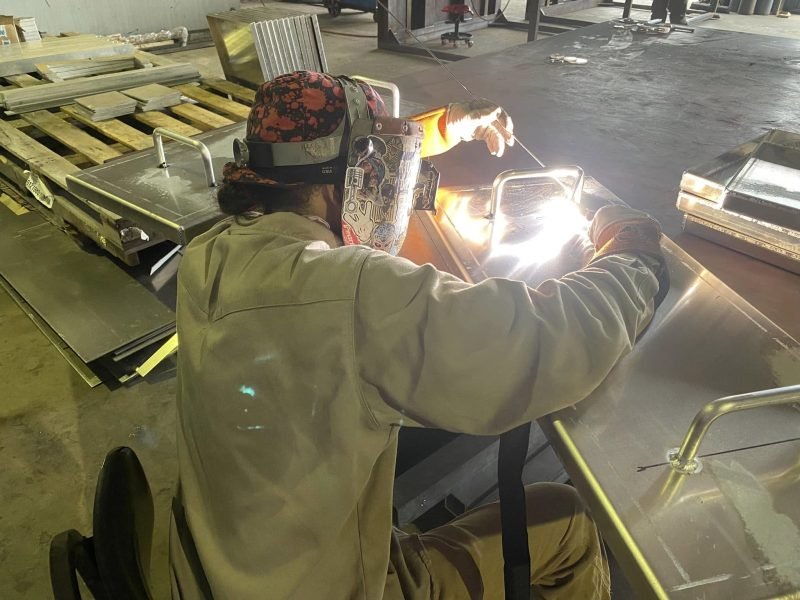
A fabrication shop is built around welding. The welder stands at a table at the right height, under good light, with the part clamped square in a fixture and every tool within reach. Power is steady, the shielding gas is in a bottle on a cart, and the air is still, so MIG and TIG run the way they are supposed to. That setting produces better welds faster, and it is where cosmetic work, tight tolerances and anything in aluminum or stainless belongs.
What that means on the finished part
- Parts can be tacked, checked for square and adjusted before final welding, so frames come out straight.
- Aluminum and stainless can be cleaned properly and TIG welded with no wind to spoil the shield.
- Welds can be ground, blended, brushed and the whole part cleaned before paint or powder coat.
- Press brake forming and CNC plasma cutting are right there, so a part can be cut, bent, welded and finished in one place.
- Heavy parts are handled with the shop's lifting equipment instead of by hand in a yard.
The shop is where cabinets, enclosures, tanks, skids, outdoor kitchen surrounds, range hoods, railing sections and gates are built. They are made in the shop and then delivered or installed. See skids and frames and enclosures and cabinets for the kind of work that stays inside until it is done.
What mobile welding gives you
A mobile welder brings a self-contained rig: a welding power source that runs off an engine, leads long enough to reach the work, rods and wire, grinders, clamps, cutting tools and the small stock needed for most repairs. The point of mobile welding is that the thing being welded does not have to move. That saves the cost and risk of hauling a gate, a trailer or a piece of equipment, and it means a repair can happen where the problem is, often the same day the welder arrives.
Jobs that belong on site
- Fence and gate repair: broken hinges, cracked frames, posts that need a new bracket welded on, a gate that sags and needs a brace.
- Trailer and equipment repair: cracked tongues and frames, broken ramps, worn bucket edges, loader and tractor attachments, broken steps and handrails on machines.
- Railing installation: shop-built railing sections welded to posts or plates that are already set in concrete.
- Structural and site work: brackets on beams, pipe supports, repairs to platforms and grating, modifications to equipment that is bolted down.
- Emergency repairs where a piece of equipment is down and the cost of waiting is higher than the cost of the welder's trip.
Carbon steel, aluminum and stainless can all be welded on site, but the process choices narrow, as the next sections explain.
Power, gas and what has to come along
In the shop, power and gas are never a question. On site they are the first thing a mobile welder plans around. Welding draws far more current than a household outlet can supply, so a mobile rig either carries its own engine-driven power source or needs a heavy electrical service close to the work. Most mobile welding runs off the rig's own engine, which means the truck has to get reasonably close to the joint. Leads can be run a long way, but every extra foot costs a little power and a lot of setup.
Shielding gas is the second question. MIG and TIG need a bottle, a regulator and still air. A mobile welder can bring a bottle for small, sheltered jobs, but on an open site stick welding or self-shielded flux-cored wire, which need no gas, are the practical choices. That is one reason site welds on steel are so often stick welds.
What helps on your end
- Clear access for the truck to within reach of the work.
- Level ground to set up on, and room to lay out leads safely.
- A note on whether site power is available, if the welder asks for it.
- The area around the joint cleared of stored material, vehicles and anything that burns.
Weather, wind and South Louisiana
Weather is the thing the shop controls and the site does not. Wind blows the shielding gas off a MIG or TIG puddle and leaves porous, weak welds, so gas-shielded processes are avoided outside unless the joint can be screened. Rain stops welding altogether: wet metal, wet leads and a welder standing in water are an electrical hazard, and moisture in the joint goes into the weld as hydrogen and can crack it later. Heat is the third factor. A summer afternoon in Acadiana with a welding hood and leathers on is hard work, and a good mobile welder plans starts, breaks and water around it.
The practical result is that mobile welding in South Louisiana leans on stick and flux-cored wire for steel, waits out rain, and dries the joint with a torch before striking an arc. Aluminum and stainless can be welded on site in sheltered spots, under a canopy, inside a building or in a lean-to, but the shop is where they are welded best. If you have aluminum or stainless work that has to happen in the field, say so when you ask, so the welder can plan shielding or suggest building the part in the shop and installing it with mechanical fasteners.
The MIG vs TIG vs stick guide explains why each process behaves the way it does in wind.
Finish quality: what you can expect from each
A weld made on a fixture in the shop and a weld made overhead on a trailer frame in a gravel lot can both be sound, but they will not look the same, and it is fair to know that before the work starts.
Shop welds on visible work are TIG welded or MIG welded and then ground, blended and finished. The part is cleaned before paint, and powder coat covers everything evenly. Field welds are made with the rod or wire that works in the conditions, the slag is chipped and the weld is wire brushed, and the joint is usually spot primed or painted on the spot. A field weld on a gate hinge or a trailer tongue is a structural repair, and it should look like a clean, even bead, but it will not look like a polished stainless seam, and nobody should expect it to.
Getting the best of both
Most installed work is a mix. Railings, gates, ramps and platforms are built in the shop, where the cosmetic welds are made and the finish is applied, and then set in place on site with a small number of field welds or bolts at the posts and anchors. Those field welds are planned so they land where they are easy to reach and easy to touch up. That is how railings and ramps and gates and fences are normally handled.
Safety on site: fuel, tanks and hot work
Welding is hot work. It throws sparks, heats metal red for a distance from the joint and can set fire to anything nearby that burns. In a shop, that is handled by the layout. On site, it has to be handled every time.
- Fuel and tanks: welding on or near a tank, drum, fuel line or vessel that has held fuel, oil, solvent or any flammable liquid is dangerous even when it looks empty. Residue and vapor can explode. Such work is only done after the container has been properly cleaned, purged and tested, and a responsible welder will refuse to do it otherwise. Tell the welder if the part has ever held anything flammable.
- Vehicles and equipment: batteries are disconnected before welding on a vehicle or machine so the welding current does not damage electronics, and fuel lines, hydraulic lines and tires are protected from heat and spatter.
- Surroundings: dry grass, stored lumber, cardboard, chemicals and gas cans are moved away, and someone keeps a fire watch with an extinguisher during and after the work.
- Industrial sites: plants and oil and gas facilities issue hot work permits, require gas monitoring and set rules for where and when welding can happen. The mobile welder works inside those rules, and the time to get through them belongs in the plan.
If the job cannot be made safe on site, it is brought to the shop, and that is a decision in your favor, not against it.
Cost: what moves the number each way
Without putting figures on it, here is what drives the cost on each side.
Mobile welding costs more per hour of welding because of
- Travel time and the trip itself, usually with a minimum charge to cover getting there and back.
- Setup and tear down on site, laying out leads, protecting the surroundings, waiting on permits or access.
- Slower welding in the field: stick welding, awkward positions, chipping slag, working around what is already there.
- Weather delays and return trips.
Shop welding costs less per weld but adds
- Transport of the part to the shop and back, or delivery.
- Removal and reinstallation if the part is already in place.
- The downtime while the part is away.
The crossover is usually obvious. A cracked trailer tongue is cheaper to fix in the driveway than to tow in. A set of twenty brackets is cheaper to make in the shop and deliver. A sagging gate is a short mobile job; a new gate is a shop build with a short install at the end. When it is not obvious, ask, and the shop will tell you which way is cheaper for that job.
How to decide, and what to send
Run through these in order and the answer usually falls out.
- Can it be moved? If yes, and it is not a hardship, shop. If no, mobile.
- What is the metal? Carbon steel welds well in the field. Aluminum and stainless strongly prefer the shop, or at least shelter.
- Is it new fabrication or a repair? New builds go in the shop and are installed afterward. Repairs to installed things happen on site.
- Does it have to look finished? Cosmetic welds and powder coat are shop work. Structural repairs can be done in the field.
- Is the site safe for hot work? If fuel, tanks, dry grass or crowded conditions cannot be managed, the part comes to the shop.
- What does the downtime cost? If a machine or trailer earning money is down, a same-day mobile repair often wins even at a higher hourly cost.
Whichever way it goes, the same information gets you a fast answer: photos of the part and the site, what it is made of, how big it is and when you need it. For a repair on site, add a photo of the access and a note about fuel or power. The guide on what to send for a fabrication quote lists it all.
Send your drawing or photos through the quote form and H&L Fabrication in Lafayette will come back with questions or a price, and will tell you whether the job belongs in the shop, on site, or a bit of both. For something that is down right now, call (337) 207-9506.