

What we build
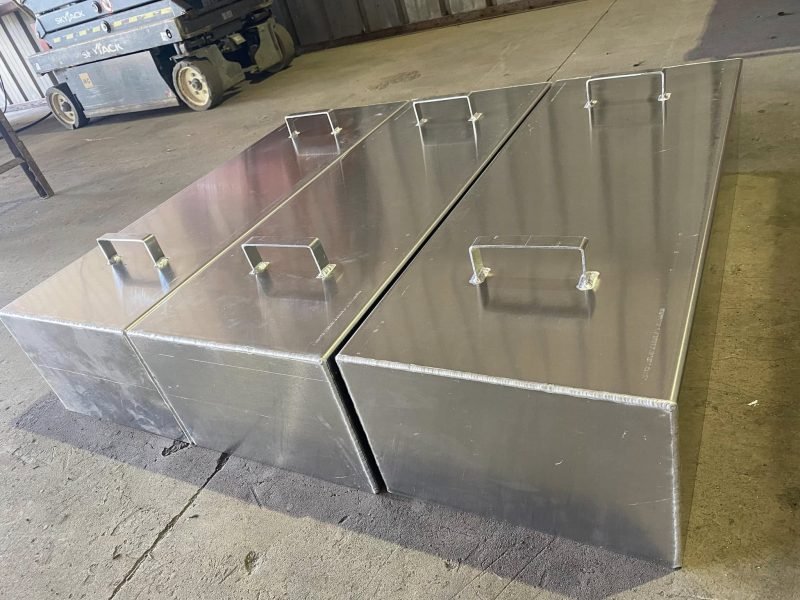
Truck boxes and tanks are a natural fit for a shop that welds aluminum every day. Both are sheet metal formed on the press brake and welded into a box that has to be strong, square and, for the tanks, tight.
- Aluminum truck toolboxes with welded compartments and perforated drain trays in the bottom
- Long cross bed boxes that span the bed behind the cab
- Side-mount and underbody boxes for service trucks and flatbeds
- Steel truck bed boxes for heavier duty and lower cost
- Welded aluminum tanks with top fittings for water, fuel transfer and fluid storage on trucks and trailers
- Skid-mounted tanks with covers for job sites and yards
Everything is built to order. There is no catalog size, which is the point: the box fits your bed and your tools, and the tank fits the space and the volume you need.
Sized to the truck bed
A stock toolbox is built for the average bed. A custom one is built for yours. We measure the inside width of the bed at the rails, the distance from the cab to the wheel wells, the rail height and the height of the cab window, so a cross bed box does not block the view out the back. If the truck has a bed liner, a tonneau or a headache rack, those get measured too.
From there the box is laid out around what goes in it. A long cross bed box can be one open cavity or split into compartments. A side box can have a tall section for a jack and a shallow tray above it for hand tools. Depth is set so the lid clears the rails and the box does not steal more bed floor than it has to. Send photos of the truck and the tools you carry, and we will sketch the layout before cutting.


Lids, hinges and latches
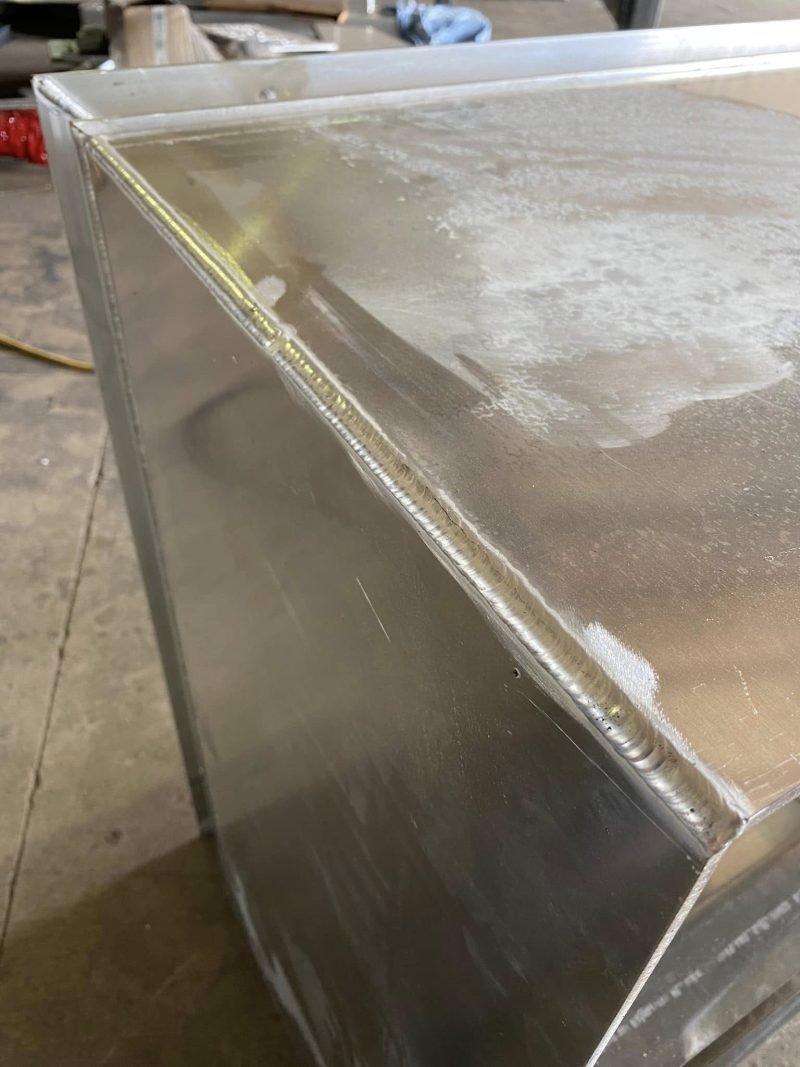
The lid is the part that gets used a thousand times, so it gets the most attention. Lids are formed with a return flange around the edge for stiffness and are fitted with a rubber bulb seal that compresses against the box when closed. A drip channel formed into the box rim catches water that runs off the lid so it does not drop into the compartment.
Hinges are stainless or aluminum piano hinge along the full length, which keeps the lid from twisting and will not rust. Gas struts hold the lid open so both hands are free. Latches are stainless paddle or T-handle latches, keyed alike across all the boxes on a truck, with a rod linkage on long lids so one latch pulls two points. Lid shape is a choice: a flat lid for a cleaner look, or a crowned lid that sheds water faster and stiffens the panel.
Compartments, trays and drains
Compartments are welded in, not screwed, so they stiffen the box and do not rattle loose. A divider between a wet area and a dry area, a slot for a chainsaw or a bar, a tall bay for cans and a shallow tray for small parts are all easy to build in while the box is on the table.
Perforated drain trays are a detail that sets a custom box apart. A removable perforated aluminum tray sits an inch above the floor of the box, so wet tools, ropes and hoses sit on the tray while water drains through to the floor and out through drain holes. The tray lifts out for cleaning. For boxes that carry fuel cans or chemicals, a welded sump with a drain plug at the low corner keeps spills from spreading.
Tanks: fittings, baffles and covers
A welded aluminum tank is a box that has to hold liquid without leaking and without fatiguing over years of road vibration. The seams are welded continuous inside and out where access allows, the corners are formed rather than welded wherever possible, and the long walls get baffles welded inside so the liquid does not slosh as one mass every time the truck brakes.
Fittings go on top wherever possible. A fill neck with a cap, a vent, a sight gauge, a suction or drain fitting and a mounting pad for a pump are the common ones. Threaded couplings are welded in with a doubler plate so the thread has something solid to bite into. A tank that will be drained from the bottom gets a sloped floor and a drain fitting at the low point. Skid-mounted tanks are welded to an aluminum or steel skid with lifting points and fork pockets, and get a hinged or lift-off cover to keep rain and debris out of the fill area.
We need to know what the tank will hold, how much, where it sits and what fittings it connects to. Fuel, water and chemicals each have their own rules on material and venting, and some fluids are not suited to aluminum at all; tell us the fluid and we will tell you what the tank should be made of.
Leak checks in plain words
Every tank is checked for leaks before it leaves. The usual method is to fill it with water and let it stand, then look at every seam and fitting for weeping. A second method is to close the fittings, put a low air pressure in the tank and brush soapy water over the seams; bubbles show a leak. Either way, any seam that shows is ground out, rewelded and checked again. Toolboxes get a water check too, with the lid closed and a hose run over the seal, so the box stays dry in the rain.
What these tanks are and are not
The tanks we build are atmospheric storage and transfer tanks: they hold liquid at or near normal air pressure, vented to the outside, for water, fuel transfer, hydraulic fluid, wash water and similar uses on trucks, trailers and skids. They are built to be tight, strong and long lasting for that job.
They are not pressure vessels. A tank that holds compressed gas or liquid under pressure is a different kind of product, designed and stamped under a pressure vessel code, and we do not build or represent our tanks as that. Likewise, a fuel tank that is part of a vehicle's own fuel system or a tank that falls under a transport regulation has its own requirements, and you should check those before ordering. If you are not sure which category your tank falls in, describe what it will hold and how it will be used, and we will tell you honestly whether it is something we build.
Aluminum or steel
Aluminum is the usual choice for both boxes and tanks on a truck. It will not rust, it is roughly a third the weight of steel, and it can be left bare with a brushed finish or a diamond plate skin. It is welded with AC TIG for the cleanest seams, or with MIG on larger boxes. The aluminum welding page explains why the process matters.
Steel makes sense for a bed box that will be loaded with heavy chain, rigging or iron, where dents matter more than weight, and for a lower cost. Steel boxes are primed and painted or powder coated, and in Lafayette humidity they need that coating kept up. Stainless is the answer when a tank or box has to carry something corrosive or sit in a wash-down area, and it costs the most. Our guide to aluminum and stainless outdoors goes deeper.
What to send for a toolbox or tank quote
For a toolbox, send photos of the truck bed, the inside width between the bed rails, the distance from cab to wheel well, and a list of what you carry. For a tank, send the volume, the fluid, the space it has to fit and the fittings it connects to. Our guide to what to send for a quote covers the rest, and the project gallery shows finished boxes and tanks.
Need a toolbox or tank built to fit? Request a quote with your measurements, or call (337) 207-9506.
