

What we build
Railing work splits into two jobs that look similar but serve different needs. A handrail is the thing you hold. A guard rail is the thing that keeps you from falling off an edge. Many of the rails we build do both at once, and the drawings or the code will usually say which one a given run has to be.
The projects that come through the shop most often include:
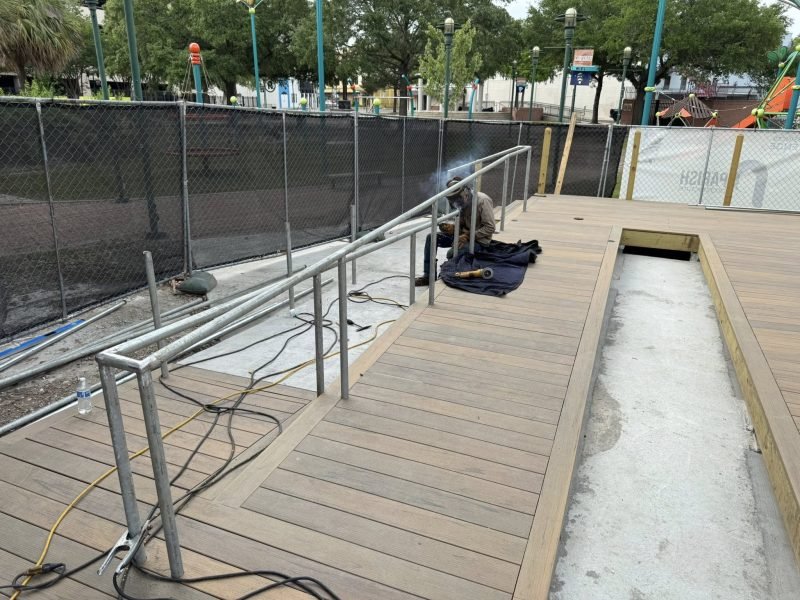
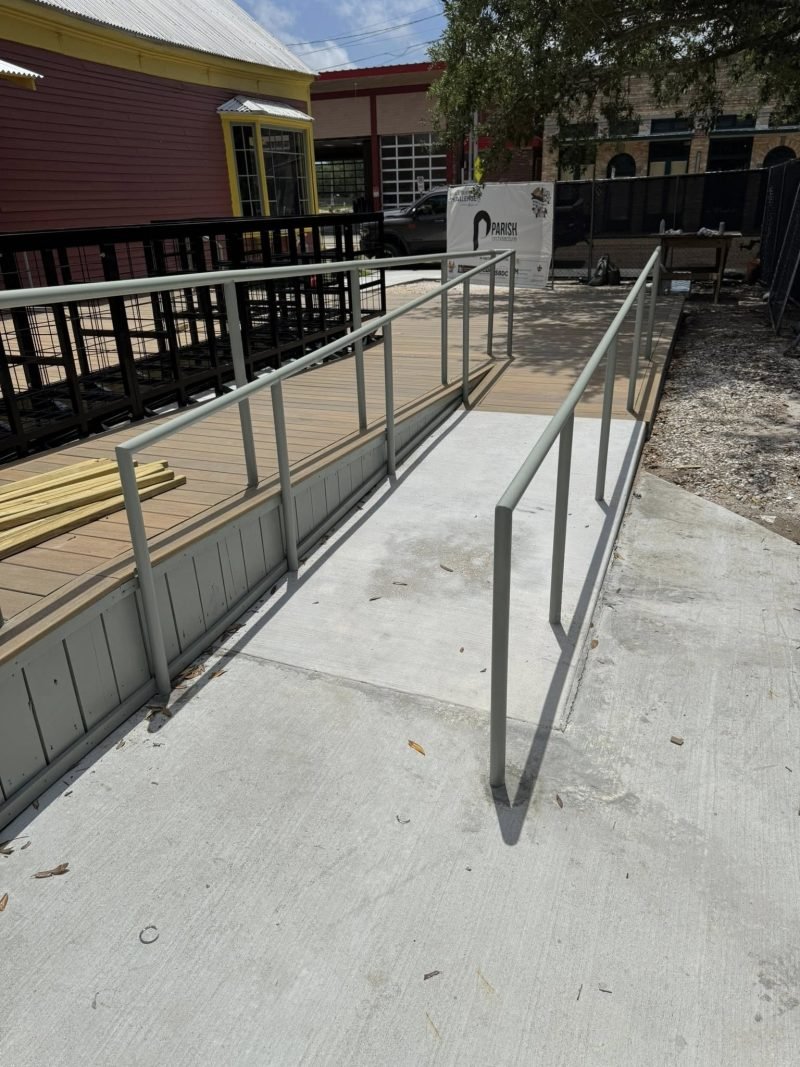
- Aluminum handrails and guard rails along ramps and decked walkways at commercial buildings
- Stair handrails at building entries, church steps and front porches
- Black steel guard railing panels for decks, balconies and landings
- Wall-mounted handrails for interior and exterior stairs
- Replacement sections where an old rail has rusted, bent or pulled loose
Every rail is built from tube or pipe with welded joints, ground smooth where hands will run, and finished to suit the material. The aluminum rails are welded with AC TIG, which is the right process for clean aluminum joints. Steel rails are MIG or TIG welded and then ground and prepped for primer and paint, or powder coating through a coating shop.
Accessible ramp handrail basics in plain words
An accessible ramp or stair has a short list of handrail requirements that come from the building code and the accessibility standard the project follows. The architect or engineer puts the exact numbers on the drawings. Here is what those rules mean in practice.
Graspable rail
The rail has to be something a hand can wrap around. Round tube or pipe in a modest diameter is the usual answer. Big flat bars and square tubing with sharp corners do not pass.
Continuous rail
Once a hand is on the rail, it should be able to slide the whole way without hitting a post or a bracket. That is why the posts attach under the rail rather than through it, and why the rail runs unbroken around landings and switchbacks.
Extensions at the ends
At the top and bottom of a ramp or stair, the rail keeps going past the last step or the end of the slope before it turns down or returns to the post. Those extensions give a person something to hold while they get their footing. The length and the way the end is finished are set by the standard.
Heights set by the drawings
Handrail height and guard height are measured from the walking surface and are spelled out in the code and on the drawings. We build to those numbers. We do not guess at them, and we do not certify compliance; the design professional and the inspector do that. What we do is build the rail accurately to the dimensions we are given and install it plumb and level so the field measurements match the drawings.
A ramp also usually needs a guard on the open side when the drop is more than a short step, plus an edge protection curb or bottom rail so a wheel cannot slip off. Those details live on the drawings too.

Aluminum or steel
Both metals make a good rail. The choice usually comes down to where the rail lives and what it needs to look like.
Aluminum does not rust, which is why it is the common choice for exterior ramps, walkways and anything near water. It is lighter, which makes long runs easier to handle during installation. Left bare it weathers to a soft gray; it can also be powder coated in any color. Aluminum is welded with AC TIG, which cleans the oxide off the surface while the weld is made. Read more on our aluminum welding page.
Steel is stronger for the same size, which lets a guard rail use thinner, more open panels and still hold up to a lean. Black steel guard railing with vertical pickets is the look most people picture on a porch or balcony. Steel needs a coating to survive South Louisiana humidity, so every steel rail is cleaned, primed and painted or powder coated before it goes out.
For an exterior rail at a commercial entry that gets daily use and little maintenance, aluminum is the usual recommendation. For a decorative residential guard where the look matters and someone will keep the paint up, steel is often the better fit. Our guide to aluminum and stainless outdoors covers the tradeoffs in more detail.
Anchoring to concrete and wood decks
A rail is only as solid as what it is bolted to. The posts carry a sideways load whenever someone leans or stumbles against the rail, so the anchor has to resist that pull, not just hold the post upright.
On concrete, posts are set one of three ways: welded to a base plate that is anchored with expansion or epoxy anchors, core drilled and grouted into the slab, or set into sleeves cast in the concrete when the slab is poured. Surface-mounted base plates are the fastest to install and the easiest to replace. Core drilling gives a cleaner look with no visible plate.
On wood decks, the posts are through-bolted to the rim joist or to blocking added between joists, never just screwed into the deck boards. Where the deck framing is too light to carry the rail load, we add a steel plate or a bracket that spreads the load across more of the structure.
Wall-mounted handrails use brackets that land on studs or on blocking behind the finish, with a bracket spacing that keeps the rail from flexing between supports.
Fabricated in the shop, welded on site
Rails are built in two stages. The runs, posts, corners and returns are cut and welded in the shop in Lafayette, on a flat table where everything can be squared and the welds ground smooth. The shop is also where the press brake forms any bent plate parts and where plate brackets and base plates are cut on the CNC plasma table. Anything that can be finished in the shop is finished there, because the result is straighter and cleaner.
The final fit happens on site with a mobile welding rig. Ramps are rarely perfectly straight or level, and the rail has to follow the slope and the turns of the ramp as built. Field welds join the shop-built sections, close the gaps at corners and tie the rail into existing posts. Those welds are ground, cleaned and touched up with the same finish used in the shop.
Mobile welding installs across Lafayette, Crowley, Abbeville, New Iberia and the surrounding Acadiana region.
Commercial and residential uses
Commercial railing work usually comes from a general contractor or a building owner with a set of drawings. Ramps and stairs at offices, churches, clinics, schools and retail buildings all need rails that match the drawings, pass inspection and hold up to daily traffic. We read the rail details, build to the dimensions, and coordinate with the contractor on when the slab or the deck is ready for anchors.
Residential railing is more often a conversation than a drawing. A front porch that needs a handrail, a deck that needs a guard, a ramp built so a family member can get into the house safely. We measure on site, suggest a rail style and material, and build it to fit. Even on a home, the rail still follows the same basic rules on height, spacing and strength, because those rules are about people not falling.
Both kinds of work show up in the project gallery, alongside the gates, platforms and stairs that often go with them.
What to send for a railing quote
For a commercial job, the rail details and the site plan are enough to start. For a home, a few things get the first conversation moving.
- Photos of the ramp, stairs, deck or porch from a couple of angles
- The length of each run and the number of steps or the slope of the ramp
- What the posts will attach to: concrete, wood deck, brick, or a wall
- Whether you want aluminum or steel, or want a recommendation
- A photo of a rail style you like, if you have one
Our guide to what to send for a quote covers the rest. Need a handrail, guard rail or ramp rail? Request a quote with your photos and measurements, or call (337) 207-9506.
