

What makes stainless steel stainless
Stainless steel is steel with enough chromium in it, around 10 percent or more, to form a thin, invisible chromium oxide film on its surface. That film is what keeps it from rusting. Scratch it and it heals itself as long as there is oxygen around and the chromium is still there. Everything about welding stainless well comes down to protecting that film and the chromium under it.
Heat is the enemy. Overheat stainless during welding and the chromium ties up with carbon in the metal, leaving a zone beside the weld that can rust. Let the hot weld see air and it grows a thick colored oxide that no longer protects. Drag a carbon steel brush across it and you embed iron particles that rust on the surface. None of this is difficult to avoid, but it has to be done every time, and that is the difference between a shop that welds stainless and a shop that welds stainless well.
H&L Fabrication welds stainless in its Lafayette shop as part of full-service welding and on site through mobile welding.
TIG and MIG on stainless
TIG
TIG is the first choice for most stainless work. It puts in the least heat, gives full control of the puddle, and leaves a clean, narrow bead that polishes out well. It is the process for sinks, countertops, range hoods, food contact surfaces, thin tube and anywhere the weld will be seen or has to be sanitary. The filler rod matches the base metal, so 308 filler on 304 and 316 filler on 316.
MIG
MIG with stainless wire is faster and suits thicker material and structural stainless, such as table frames, equipment stands, brackets and supports. It runs with a gas mix made for stainless rather than the plain mix used on carbon steel. MIG beads are wider and take more work to blend if they are to be polished, so on visible surfaces the shop weighs speed against finishing time.
Stainless needs less heat than carbon steel and carries heat away more slowly, so the puddle stays hot in one place. Short welds, breaks to let the part cool, and clamping to heavy fixtures keep thin stainless flat. The MIG vs TIG vs stick guide explains how the three processes differ.
Shielding gas and back purging, in plain words
Every arc weld is protected by a cloud of gas that keeps air away from the molten metal. On the top side of the joint, the torch supplies that gas. On the back side of a full-penetration weld, nothing protects the metal unless the welder does something about it.
On carbon steel, a little oxidation on the back of a weld is harmless. On stainless, the back side of an unprotected weld turns black, crusty and rough, a condition welders call sugaring. The sugared surface has lost its chromium and will rust, and in a sink, tank or food surface that rough backside is a place for bacteria and corrosion to start.
Back purging is the fix. The welder floods the back side of the joint with argon, usually by taping off the inside of a tube or sealing the underside of a seam and feeding gas into it until the air is pushed out. Then the weld is run while the purge keeps flowing. Trailing shields and purge dams do the same job on open surfaces. It takes extra time and gas, and on sanitary work it is not optional.
Heat tint and passivation
After welding, stainless shows bands of color beside the bead, from pale straw through blue to dark grey. That is heat tint, a thickened oxide layer that formed while the metal was hot. Light straw tint is mostly cosmetic. Blue and darker tint means the surface oxide has pulled chromium out of the metal under it, and that band will rust before the rest of the part does.
Removing heat tint and restoring the surface is a finishing step, not an afterthought.
- Mechanical cleaning. Abrasive discs, flap wheels and stainless-only brushes remove the tint and blend the weld. Tools used on carbon steel are never used on stainless, because iron contamination causes rust spots later.
- Pickling. An acid paste or gel applied to the weld area dissolves the tinted oxide and the chromium-depleted layer under it, then is rinsed off. It is the most complete way to remove tint.
- Passivation. A milder acid treatment, often citric or nitric, that strips free iron from the surface and lets the protective chromium oxide film re-form evenly. Passivation is standard on food contact and marine work.
A stainless part that leaves the shop with tint still on the welds will start to show rust streaks at those welds within a year outdoors in South Louisiana. Cleaning it properly is what makes the part last.
304 and 316, in general terms
Two grades cover almost all fabrication work.
304
304 is the everyday stainless. It is the grade of most kitchen equipment, work tables, sinks, range hoods, brackets and railings. It welds well, forms well on the press brake, and resists most household and shop chemicals. Its weak spot is chlorides. Salt air, pool chemicals and bleach can pit 304 over time.
316
316 adds molybdenum, which makes it much more resistant to chlorides and pitting. It is the grade for marine exposure, coastal properties, outdoor kitchens near the water, chemical contact and anywhere salt is in the air. It costs more and welds nearly the same as 304. Along the Louisiana coast and around the bays and marshes, 316 is often worth the difference on anything that will sit outside.
Both grades come in a low carbon version, 304L and 316L, which is what the shop prefers for welding because the lower carbon reduces the chance of corrosion beside the weld. Sheet for countertops and hoods is usually 304 or 316 in 16 or 18 gauge; tube and plate for frames and supports run thicker. The grade and thickness are chosen for the environment and the load, and the shop will recommend one if you are unsure.
Where stainless fits
Stainless is the right metal where cleanliness, food safety, heat and corrosion all matter at once. These are the stainless projects H&L Fabrication builds most.
- Outdoor kitchens. Grill surrounds, countertops, doors, drawers and backsplashes built to the grill and the masonry. See outdoor kitchens and range hoods.
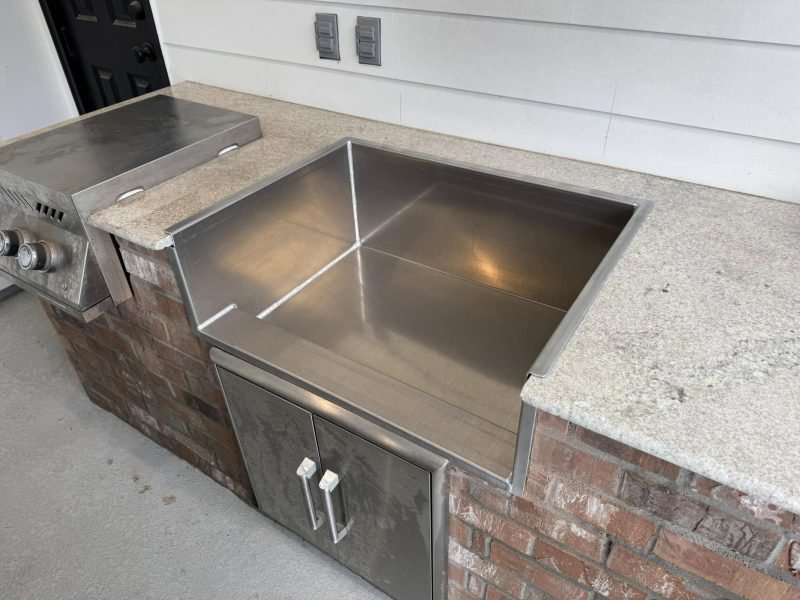
- Sinks and drainboards. Welded corner sinks, deep bowls, integral drainboards and backsplashes that drain properly and clean easily.
- Range hoods. Residential and commercial hoods in stainless, with the seams welded, blended and finished to match the appliances.
- Work tables and stands. Flat, square, welded tables with undershelves and casters for kitchens, labs and shops.
- Food contact surfaces. Prep surfaces, splash guards and shelving with welds ground smooth, no crevices and a cleanable finish.
- Marine exposure. Brackets, rails, cleats and hardware in 316 for boats, docks and coastal homes.
For an honest comparison of stainless and aluminum outdoors, read aluminum vs stainless outdoors in South Louisiana.
Finishes, brushed and polished
Stainless is sold with a finish already on it, and the finishing work in the shop is about blending welds so the finished part looks like one piece of metal.
- Brushed, often called #4. The familiar linear grain on commercial kitchen equipment and most appliances. Welds are ground flush and the grain is re-laid across the joint so it disappears. Brushed hides fingerprints and small scratches well and is the usual choice for hoods, counters and tables.
- Mirror polish, often called #8. A reflective finish built up through finer and finer abrasives and buffing compounds. It is beautiful and it shows every fingerprint and scratch. It suits trim, decorative panels and architectural pieces more than working surfaces.
- Bead blast. A matte, uniform finish with no grain direction. Good for hiding wear on handrails and parts that get handled.
- Mill finish. As supplied, with welds cleaned. Fine for frames, supports and anything hidden.
Finishing stainless well takes almost as long as welding it. When you ask for a quote, say which surfaces will be seen and which finish you want, because that drives the labor more than the metal does.
What to send for a stainless quote
Send a sketch or drawing with dimensions, photos of the space or the equipment the part has to fit, and a note on the environment: indoors, covered patio, open to the weather, near salt water, food contact or not. Tell us which surfaces will be visible and what finish you want on them. If you are matching an existing appliance or hood, a photo of it helps the shop match the grain. For repairs, send photos of the damage and the whole item. The quote guide lists everything that speeds a quote along.
H&L Fabrication is a custom shop in Lafayette, Louisiana serving Acadiana and South Louisiana. Call (337) 207-9506, email hlfabrication@outlook.com, or request a quote for your stainless steel project.