

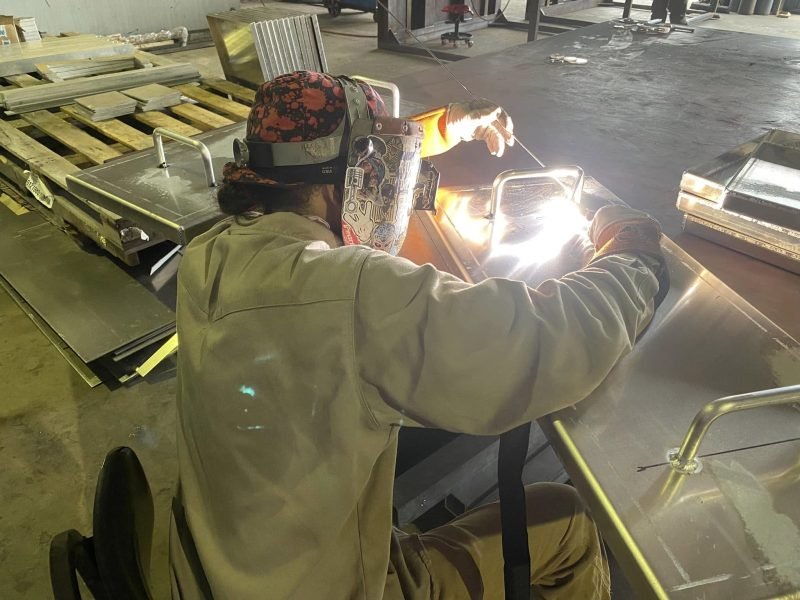
The three processes in one minute
All three processes do the same basic thing: they make an electric arc between an electrode and the metal, the arc melts the metal, filler metal is added, and the molten puddle is protected from the air until it freezes. What separates them is how the filler gets to the puddle and how the puddle is shielded.
- MIG (GMAW, gas metal arc welding): a machine feeds a continuous wire through a gun. The wire is both the electrode and the filler. A bottle of shielding gas flows out of the gun nozzle to protect the puddle.
- TIG (GTAW, gas tungsten arc welding): the arc comes off a tungsten electrode that does not melt. The welder feeds a separate filler rod in by hand and controls heat with a foot pedal or thumb control. Argon from the torch shields the puddle.
- Stick (SMAW, shielded metal arc welding): a flux-coated rod is the electrode and the filler. The flux burns off and makes its own shielding gas and a layer of slag over the weld. No gas bottle needed.
A full-service shop runs all three. The welding service at H&L Fabrication covers MIG, TIG and stick on carbon steel, aluminum and stainless, so the question is never which process the shop can do, it is which process fits the job in front of it.
MIG welding: speed and clean work in the shop
MIG is the workhorse of almost every fabrication shop. Because the wire feeds itself, the welder does not stop to change rods, and travel speed is high. On carbon steel from thin sheet up through plate, MIG puts down more weld per hour than either of the other two processes. There is no slag to chip, so the weld comes out of the shop ready for grinding, paint or powder coat with very little cleanup.
MIG is at its best in a controlled space. The shielding gas is a soft cloud around the nozzle, and a breeze will blow it away and leave porosity, the little pinholes that weaken a weld and show up under paint. That is why MIG lives in the shop and rarely goes out in the field unless the joint can be tented or shielded.
Where MIG fits
- Steel frames, tables, skids, brackets, enclosures and anything with a lot of feet of weld.
- Sheet metal and tube where speed and low distortion matter.
- Production runs where the same part is welded again and again.
- Stainless, with the right gas mix and wire, when the finished look does not have to be TIG quality.
- Aluminum, with a spool gun or push-pull gun and pure argon, on thicker material.
Where MIG struggles
Wind, dirty or rusty metal, and very thin material where a quick burst of wire can blow through. MIG also needs reasonably clean base metal; mill scale and rust should come off before welding or the weld will trap contamination.
TIG welding: precision, thin material, aluminum and stainless
TIG is the slowest of the three and the most controllable. The welder holds the torch in one hand, feeds filler with the other and runs the heat with a foot pedal, so the puddle can be grown, held and shrunk as the joint changes. There is no spatter, no slag and no wire stubbing into the puddle. A good TIG weld on stainless or aluminum looks like a stack of dimes and often needs no cleanup at all.
That control is what makes TIG the right answer on thin material. Sixteen gauge stainless, thin wall tube, aluminum sheet and small parts that would warp or burn through under MIG all weld cleanly with TIG. It is also the process of choice when the weld is going to be seen: handrails, outdoor kitchen surrounds, range hoods, stainless sinks and anything with a brushed or polished finish.
What TIG asks for in return
- Clean metal. TIG does not tolerate oil, paint, rust or oxide. Stainless and aluminum are wiped and brushed with dedicated brushes before the arc ever strikes.
- Time. A TIG joint can take several times longer than the same joint with MIG, and that shows up in the labor on a quote.
- Still air. Like MIG, TIG relies on a gas shield and does poorly in wind.
- Tight fit-up. TIG bridges gaps poorly compared with stick or MIG, so parts need to be cut and fit well.
For material-specific notes see the stainless steel welding and aluminum welding pages.
Stick welding: thick steel, wind and rough conditions
Stick is the oldest of the three and still the one that gets called when conditions are bad. The flux on the rod makes its own shielding, so there is no gas bottle to haul and no shield to blow away. Stick welds through light rust, mill scale, paint and damp metal that would ruin a MIG or TIG weld. It runs well on thick plate, structural shapes, pipe and heavy repair work, and it welds in every position, including overhead.
The trade-off is cleanup and speed. Every pass leaves a layer of slag that has to be chipped and brushed off before the next pass, and the welder stops to change rods every few inches of weld. Stick is also hard on thin material; below about an eighth of an inch it takes real skill to avoid burning through.
Common rods and what they are for
- 6010 and 6011: deep penetrating, fast freezing rods for dirty metal, root passes and out-of-position work.
- 7018: a low hydrogen rod for strong, clean welds on structural steel. It has to be kept dry, usually in a rod oven, or it picks up moisture and causes cracking.
- Stainless rods such as 308L and 309L: for stainless to stainless and stainless to carbon steel joints when TIG or MIG are not practical.
Stick is the reason a mobile welder can show up to a fence line, a trailer or a piece of equipment in a field and make a sound repair without a shop around it. See the mobile welding page for how that work is handled.
Thickness, position and joint type
Three questions narrow the choice quickly: how thick is the metal, where is the joint, and what does the joint look like.
Thickness
Thin material, roughly 16 gauge and under, favors TIG, with short-circuit MIG close behind on steel. Medium material from an eighth to a half inch is MIG country in the shop and stick in the field. Thick plate over a half inch is welded with multiple passes by any of the three, but stick and MIG get there faster, and the joint is usually beveled first so the weld reaches full depth.
Position
Flat and horizontal welds are easy for every process. Vertical and overhead welds change the picture. Stick and short-circuit MIG handle out-of-position work well because the puddle freezes fast. Spray-transfer MIG, the high heat setting used on thick plate, only works flat or horizontal because the puddle is too fluid to stay put. TIG works in every position but is slow going overhead.
Joint type and fit-up
Gaps and poor fit-up favor stick and MIG, which can bridge and fill. Tight, clean fit-up with no gap is where TIG shines. Fillet welds on structural work are usually MIG or stick. Edge welds and outside corners on thin sheet, where you want a small bead you can blend, are usually TIG.
Aluminum: why it needs AC TIG or a spool gun
Aluminum is the material that most often decides the process by itself. Three things make it different from steel.
First, aluminum is covered in a thin, tough oxide skin that melts at roughly three times the temperature of the metal under it. Weld through that skin and you get a dirty, weak weld. TIG on alternating current (AC) solves this: during half of each cycle the arc pushes electrons from the work to the tungsten and breaks the oxide apart, a cleaning action you can watch on the puddle. That is why aluminum TIG is done on AC, not the DC used for steel and stainless, and why the welding service page lists AC TIG for aluminum.
Second, aluminum pulls heat away from the weld fast. It takes a surprising amount of heat to start the puddle, and then the part gets hot and wants to fall through. Preheat on thick sections, a hot start and a quick finish all come from experience.
Third, aluminum wire is soft. Push it through a long MIG gun liner and it kinks and tangles at the feeder. A spool gun, which holds a small spool of wire right on the gun, or a push-pull gun with a motor in the handle, feeds the soft wire a few inches instead of several feet. With pure argon and one of those guns, MIG on aluminum works well on thicker sections like toolboxes, tanks and truck beds where TIG would be too slow.
The short version: thin aluminum and anything cosmetic gets AC TIG; thicker production aluminum gets MIG with a spool gun. Both need clean metal brushed with a stainless brush used only on aluminum. More on this on the aluminum welding page.
Stainless steel and the processes that fit it
Stainless welds with all three processes, but it punishes sloppy heat control. Put too much heat in and the part warps, the surface turns dark and rainbow colored, and the metal next to the weld can lose some of its corrosion resistance. The goal on stainless is always the least heat that will make a sound weld.
- TIG is the default for thin stainless, sinks, hoods, food and outdoor kitchen work, and any joint that will be seen or polished. Back purging with argon on tube and pipe keeps the inside of the weld clean and bright.
- MIG with stainless wire and an argon-rich gas mix is the choice for thicker stainless frames, enclosures and brackets where speed matters more than a mirror finish.
- Stick with stainless rods covers field repairs and heavy sections, especially where gas shielding is not practical.
Whatever the process, stainless has to be kept away from carbon steel. Grinding dust, a wire brush that touched steel, or a steel clamp can leave iron on the surface that rusts later. Careful shops keep separate brushes, discs and even separate work areas for stainless.
Outdoor and field work: wind changes the answer
In the shop the choice is driven by metal, thickness and finish. Outside, the weather joins the list. Any breeze over a few miles an hour will strip the shielding gas off a MIG or TIG puddle. Welders can block it with screens or a tarp on a small joint, but on a fence run, a dock or a trailer frame in an open yard that is not realistic.
That is why field welding leans on stick, and sometimes on self-shielded flux-cored wire, a MIG-style wire with flux inside it that makes its own shielding the way a stick rod does. Both work in wind, both tolerate rust and paint, and both can run off an engine-driven welder with no gas bottle. The welds are strong and sound; they just need more cleanup and are not as pretty as shop TIG.
Rain and damp metal matter too. Moisture in the joint turns to hydrogen in the weld and can crack it, especially on thick steel with 7018. A good field welder dries the joint with a torch before striking an arc and keeps low hydrogen rods sealed until they are needed.
Humidity in South Louisiana makes this a year-round habit, not a winter one. For a fuller comparison of what belongs in the field and what belongs in the shop, read the guide on shop welding vs mobile welding.
How a shop picks the process for your job
When a drawing or a photo comes in, a fabricator runs through a short list, usually in this order.
- What is the metal? Aluminum goes to AC TIG or spool gun MIG. Stainless goes to TIG for thin and visible work, MIG for heavier work. Carbon steel can go anywhere.
- How thick is it? Thin leans TIG, medium leans MIG, thick leans MIG or stick with beveled joints and multiple passes.
- Where will it be welded? In the shop, MIG or TIG. On site in the open, stick or flux-cored.
- What does it have to look like? Hidden structural welds get the fastest sound process. Visible welds on railings, kitchens and hoods get TIG and the time that goes with it.
- What does it have to hold? Structural, pressure and lifting applications get the process and filler the application calls for, and the welder sizes and sequences the welds to match.
- How many? One-off repairs favor whatever is fastest to set up. Production runs favor MIG with fixtures.
Most jobs are not a single answer. A stainless outdoor kitchen frame might be MIG welded inside where nobody will see it and TIG welded on the visible top and edges. A steel gate might be MIG welded in the shop and stick welded to its posts on site. That mix is normal, and a good shop will tell you which welds are which before the work starts.
You do not need to pick the process yourself. Send your drawing or photos through the quote form and H&L Fabrication in Lafayette will come back with questions or a price, including which process the shop would use and why.