

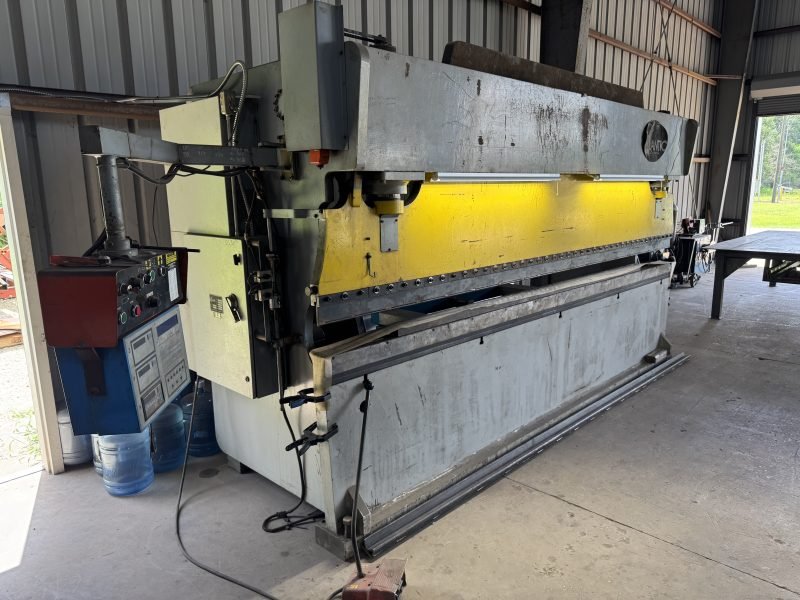
What a press brake does
A press brake is a long, narrow press. A sheet or plate of metal is laid across a bottom die with a V-shaped groove in it, and a top tool called a punch comes down into the groove and folds the metal around its tip. Move the metal, bend again, and a flat blank becomes a channel, an angle, a box, a bracket or a cabinet body. Nearly every enclosure, pan, tray, bracket, hood and skid cross member in a fabrication shop has been through a press brake.
Two numbers describe every brake: tonnage, the force it can apply, and bed length, the length of the tooling it can hold. A machine is sold as, for example, a 200 ton by 14 foot brake. Those numbers are what decide whether your part can be bent on that machine, in one hit or several, and what the bend will look like when it is done. The press brake work page describes the service; this guide explains the numbers.
Tonnage: how thickness, length and die opening add up
Bending metal takes force, and the force depends on four things: how strong the material is, how thick it is, how long the bend is, and how wide the V opening in the bottom die is. Three of those make the force go up: stronger material, thicker material and a longer bend. A wider die opening makes the force go down, because the metal has more leverage over the groove, at the cost of a larger bend radius.
The relationship with thickness is steep. Doubling the thickness takes roughly four times the force, not twice. That is why a brake that bends thin sheet all day long can run out of tonnage quickly on plate. The relationship with length is simple: tonnage is quoted per foot of bend, so a bend twice as long takes twice the force.
A worked example in round numbers
For mild steel, air bending over a die opening about eight times the material thickness, a common rule of thumb puts a 1/4 inch plate at roughly 15 tons for every foot of bend. A 2 foot bracket in 1/4 inch plate therefore needs around 30 tons, and a 14 foot bend in 1/4 inch plate needs around 200 tons. Thinner material drops fast: 10 gauge sheet needs a fraction of that per foot, and 16 gauge a fraction again. Thicker plate climbs just as fast the other way, so 1/2 inch plate at full length is beyond a 200 ton machine and is bent in shorter lengths or on a larger die opening.
Stainless steel takes roughly half again more force than mild steel at the same thickness. Aluminum in the common 5052 and 6061 alloys takes somewhat less. The shop runs these numbers from a tonnage chart for every job; the point for a buyer is to see why thickness and length matter so much on a quote.
Bed length: the longest bend in one stroke
Bed length is simply how long the tooling is, and so how long a single bend can be. A 14 foot bed takes a 12 foot sheet with room to spare on each end, and it handles the long parts that smaller brakes cannot: full-length channel for skids and frames, long angle for platform edges, wide cabinet bodies, extended toolbox lids, enclosure panels and long drip edges and flashings. A part that is longer than the bed can sometimes be bent in two overlapping hits, but the joint between the hits rarely looks clean, so a bed longer than the part is always better.
Bed length also lets a shop stage several tooling setups across the bed at once. A short part with three different bends can have three tool sets side by side, so the operator moves the part from station to station without changing tools. On a production run of brackets or box parts, that is a real time saver and it shows up in the per-piece price.
Put the two numbers together and the meaning of a 14 foot, 200 ton brake becomes plain: full-length bends in sheet and lighter plate, long structural shapes for skids and frames, and multi-station work on cabinets and enclosures. It also means that very thick plate is bent in shorter lengths, which is normal for any brake in this class.
Bend radius: why the inside corner is never sharp
A bent corner has an inside radius and an outside radius. Drawings often show a sharp inside corner, but metal does not bend that way; it folds around a radius, and if the radius is too small for the material it cracks along the outside of the bend. The inside radius is what the shop controls.
In air bending, the most common method, the punch pushes the sheet into the V without pressing it all the way to the bottom, and the inside radius comes mostly from the width of the die opening, not from the tip of the punch. A wider V makes a larger radius and needs less tonnage; a narrower V makes a tighter radius and needs more. For mild steel over a V about eight times the thickness, the inside radius lands close to the material thickness, which is why "inside radius equals thickness" is the usual shop default.
Minimum radius by material
- Mild steel: about one times thickness is comfortable. Tighter is possible on thin material.
- Stainless: about one to one and a half times thickness.
- 5052 aluminum: about one times thickness; it bends well.
- 6061-T6 aluminum: two to three times thickness or more, and it still likes to crack. Tight bends in 6061 often mean choosing 5052 instead or bending across the grain with a generous radius.
If your drawing needs a sharp inside corner for a reason, say so and the shop can discuss coining, a different material or welding two plates instead of bending one.
K-factor and bend allowance in plain words
When metal bends, the outside of the bend stretches and the inside compresses. Somewhere between them is a line that does neither, called the neutral axis. The length of the flat blank is the length of that neutral line through every flange and every bend, and getting it right is what makes the finished part land on dimension.
K-factor is a number, usually between 0.3 and 0.5, that says where the neutral axis sits as a fraction of the thickness. Thin material bent on a large radius has a K-factor near the middle; thick material on a tight radius has the neutral axis pulled toward the inside. The shop sets K-factor from experience with its tooling and material, and it is the number CAD programs ask for when they unfold a 3D model.
Bend allowance is the length of the neutral axis through the bend itself, the amount of material that lives in the curve. Bend deduction is the related number used the other way: the amount to subtract from the sum of the outside flange lengths to get the flat length. A shop uses one or the other depending on how the part is dimensioned.
What this means for you: if you send outside dimensions of the finished part, the shop will work out the flat for you, and that is the normal way to do it. If you send a flat pattern you unfolded yourself, say what K-factor, radius and thickness you used, so the shop can check it against its tooling before cutting. The CNC plasma cutting guide covers how flats are cut once they are worked out.
Grain direction and springback
Grain
Rolled sheet and plate have a grain that runs the length of the sheet, like wood. Bending parallel to the grain is more likely to crack along the outside of the bend, especially on tight radii, aluminum and higher strength steel. Bending across the grain is safer. Good nesting lays flat parts on the sheet so critical bends run across the grain, and when a part has bends in both directions the tighter one gets the better orientation. For most mild steel at normal radii it hardly matters; for 6061 aluminum and thick plate it matters a great deal.
Springback
Metal is elastic. Bend it to 90 degrees and release the punch and it relaxes a degree or two, sometimes more. That relaxation is springback, and the operator overbends to compensate, pushing a little past 90 so the part settles at 90. Springback is larger on stainless, on aluminum, on higher strength steel, and on large radii, and smaller on mild steel bent on a tight radius. It also varies a little from sheet to sheet, which is why the first bend of a run is checked with a protractor and the brake adjusted before the rest are made. Modern brakes have angle correction built into the control, but an experienced operator still checks the first part.
Minimum flange, hems and holes near bends
Minimum flange length
A flange has to be long enough to sit across the V opening while the punch comes down, or it slips into the groove and the bend is ruined. As a rule, the shortest flange is a bit less than the die opening, which for mild steel works out to roughly four to six times the material thickness on thin sheet and more on plate. A short return lip on a cabinet edge or a small tab on a bracket may need a narrower die, which needs more tonnage, or a change in the design. Tell the shop when a flange has to be short and it will choose tooling to suit.
Hems
A hem is a flange folded back flat on itself, used to stiffen a sheet edge and remove a sharp edge on panels, doors, lids and trim. Hems come in open, closed and teardrop styles and are formed in two steps: an acute bend, then a flattening pass. Hems need thin material, special tooling and more tonnage than the bend would suggest for the flattening pass. On thick plate a hem is not practical and a welded edge bar does the same job.
Holes and cutouts near a bend
A hole too close to a bend line stretches into an oval as the metal bends. The common rule is to keep the edge of a hole at least two and a half times the thickness plus the bend radius away from the bend line. If a hole has to be closer, it can be cut after bending, or a relief can be added. The same goes for slots, notches and the ends of flanges, which need small relief cuts where two bends meet so the corner does not tear.
Tolerances and what bent parts can hold
A press brake is a forming tool, not a machining tool, and its tolerances reflect that. Angles on a well set up brake hold to within about a degree, flange lengths to within a few hundredths of an inch on short parts and a little more on long ones, and overall dimensions stack up with each bend. Material thickness varies within the mill tolerance from sheet to sheet, and that variation alone changes the bend. Long parts can bow slightly along the bend, which is tuned out with crowning on the brake but never fully eliminated on very thin, very long bends.
For most fabrication, those tolerances are more than enough. Where a dimension has to be tighter, the shop can bend oversize and trim, cut holes after bending, or weld and machine a feature instead of forming it. The time to raise a tight tolerance is on the drawing, before the first sheet is cut.
What to tell the shop about a bent part
A good bending quote comes from a short list of facts. Send as many as you have.
- Material and thickness: for example 11 gauge mild steel, 1/4 inch A36 plate, 0.125 inch 5052 aluminum, 16 gauge 304 stainless.
- A drawing of the finished part with flange lengths and angles, ideally with inside or outside dimensions marked so there is no doubt which you mean. A 3D model is better still, because the shop can unfold it with its own K-factor.
- Bend radius: "shop standard" is fine for most work. Call out any radius that matters, and any corner that has to be sharp.
- Quantity: one part is set up and bent; fifty parts are set up with stops and fixtures and run.
- Which side shows: tooling leaves faint marks on the outside of a bend. If one face is cosmetic, say which, so it can be protected or the marks put on the hidden side.
- Finish and what happens next: whether the part will be welded, powder coated, painted or left bare, and whether holes and cutouts are needed before or after bending.
- Tolerances that matter: only the ones that do. Everything else runs to normal shop practice.
With that in hand, the shop can check tonnage, pick the die, confirm the bend sequence and give you a price without guessing. Send your drawing or photos through the quote form and H&L Fabrication in Lafayette will come back with questions or a price.