

Why aluminum welds differently than steel
Aluminum is light, it does not rust, and it carries heat away from the weld faster than steel does. Those same qualities make it harder to weld well. The metal conducts heat so quickly that a welder has to put a lot of energy into the joint to get it to melt, and once it melts it goes from solid to liquid with almost no color change to warn you. Steel glows red before it flows. Aluminum just drops.
Aluminum also wears a thin oxide skin that forms the moment bare metal meets air. That skin melts at roughly three times the temperature of the metal under it. If it is not removed or broken up, the weld sits on top of the oxide instead of fusing into the base metal, and you get a joint that looks fine and fails under load. Every good aluminum weld starts with cleaning and uses a process that can break that oxide during the weld.
H&L Fabrication works aluminum every week, in both shop welding and mobile welding at the customer's location across Acadiana.
AC TIG and spool gun MIG, which one and why
There are two practical ways to weld aluminum, and the shop uses both depending on the job.
AC TIG
TIG uses a tungsten electrode, a foot or hand control for the heat, and a filler rod fed by hand. For aluminum the machine runs on alternating current. The half of each cycle that flows one way cleans the oxide off the surface, and the half that flows the other way puts heat into the metal. That is why aluminum needs AC TIG and not the DC setting used on steel. AC TIG gives the most control and the cleanest result, which matters on thin material, on visible joints like railing posts and cabinet corners, and on tanks that have to hold liquid without a leak.
Spool gun MIG
MIG feeds wire from a spool through a gun and melts it with a continuous arc. Aluminum wire is soft, so pushing it through a long cable tends to kink and jam. A spool gun carries a small spool of wire right at the gun, so the wire only travels a few inches. Spool gun MIG is faster than TIG and suits thicker material, long structural seams, toolbox bodies, ramp frames and trailer repair where speed and penetration matter more than a jewelry finish.
If a job needs to look good and seal tight, it usually gets TIG. If it needs to be strong, long and done efficiently, it usually gets the spool gun. Many projects get both. The MIG vs TIG vs stick guide covers the differences in more detail.
Cleaning and the oxide layer
Dirty aluminum makes porous welds. Oil, cutting fluid, shop dust and the oxide skin all turn into gas bubbles trapped in the weld, and bubbles mean weak spots and leaks. Prep is not optional on this metal.
- Degrease first with a solvent that leaves no residue. Wiping oxide into the metal with a dirty rag makes things worse, so degreasing comes before any abrasive work.
- Remove the oxide with a stainless steel wire brush that is used only on aluminum. A brush that has touched steel carries steel particles into the joint.
- Weld soon after cleaning. The oxide starts to re-form right away, so a part cleaned yesterday gets brushed again today.
- Keep filler rod and wire clean and dry. A rod handled with greasy gloves puts that grease straight into the weld.
On repair work, especially trailers and equipment that have lived outdoors, cleaning takes longer than the welding. Old paint, road grime and corrosion products all have to come off before an arc is struck. That time is part of an honest aluminum repair.
Heat, heat sinks and distortion
Because aluminum pulls heat away so fast, the whole part warms up while you weld it. A long seam on a thin sheet will pull, bow and oil-can if the heat is not managed. The ways a shop controls that are simple and come from experience rather than equipment.
- Tack welds at intervals before running any seam, so the parts hold their position while the joint is completed.
- Skip welding and back-stepping, running short lengths in a sequence that spreads the heat instead of piling it in one spot.
- Heavy backing bars or copper blocks under the joint to pull heat out of thin material and support the molten pool.
- Clamping to a flat table during welding and letting the part cool in the fixture.
- Preheating thick sections so the weld does not have to fight a cold mass of metal that keeps sucking heat out of the arc.
On a toolbox or cabinet, distortion shows up as doors that do not close square and lids that rock. On a tank it shows up as a seam that cracks later. Planning the weld sequence before starting is how a shop avoids both.
5052 and 6061, the two alloys you will hear about
Most aluminum work in a fabrication shop uses one of two alloys, and the choice affects how the part is formed, welded and finished.
5052
5052 is a sheet alloy. It bends well, resists corrosion very well, and welds easily. It is the usual choice for toolboxes, truck boxes, cabinets, lockers, tank shells and anything that has to be formed on the press brake and then welded. It is also the better choice near salt air and in damp conditions, which describes most of South Louisiana.
6061
6061 is a structural alloy, usually bought as extrusions, tube, angle, channel and plate. It is stronger and stiffer than 5052 and machines cleanly, so it is the usual choice for railings, ramp frames, trailer frames and anything that carries load. It cracks if bent tightly, so sharp bends are designed out of it. The heat of welding softens 6061 in a band beside the weld, so a good design keeps welds away from the points of highest stress where it can.
Filler choice matters too. 4043 and 5356 are the common filler alloys. 4043 flows well and resists cracking. 5356 is stronger and holds color better after anodizing. The shop picks the filler to match the base metal and how the part will be used.
Where aluminum fits
Aluminum earns its place where weight and corrosion matter more than raw stiffness and cost. These are the aluminum projects H&L Fabrication builds and repairs most often.
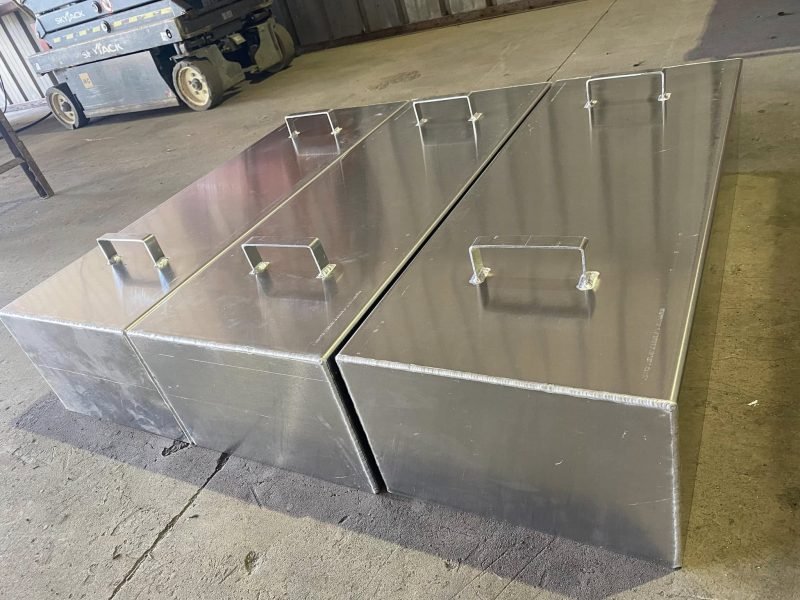
- Toolboxes and truck boxes. Diamond plate or smooth sheet, built to the truck or trailer, with welded seams, gas struts, latches and drip rails. See toolboxes and tanks.
- Tanks. Fuel, water and hydraulic tanks with baffles, bungs and fittings, welded with TIG so the seams seal.
- Cabinets and lockers. Storage cabinets for shops, rigs and service bodies that will not rust from the inside out. See enclosures and cabinets.
- Railings and ramps. ADA ramp handrails, stair rails and walkway rails that stay light enough to install by hand and never need paint. See railings and ramps.
- Trailer and equipment repair. Cracked frames, torn fenders, broken ramps and worn hinges on aluminum trailers, boats and equipment, in the shop or on site.
For a comparison of aluminum and stainless steel outdoors, read aluminum vs stainless outdoors in South Louisiana.
Finishing aluminum
Aluminum does not need a coating to survive outdoors, which is one reason people choose it. It can still be finished for looks or for wear.
- Mill finish. Left as it comes from the supplier, with welds brushed or ground smooth. The surface dulls to a soft grey over time and that is fine for most work.
- Brushed. A uniform linear grain put on with abrasives. Hides handling marks and gives a clean look on cabinets and railings.
- Powder coat. A dry powder baked onto the part for color and extra scuff resistance. Aluminum takes powder coat well once it is cleaned and pretreated.
- Paint. Possible with the right etching primer, but powder coat usually holds up better on aluminum.
Weld appearance is part of finishing. TIG welds on aluminum can be left as stacked beads where that look is wanted, or ground and blended flush where a smooth surface is needed.
What to send for an aluminum welding quote
A quote goes faster when the shop can see what you have in mind. For new fabrication, send a sketch with dimensions, a drawing or a photo of something similar, and tell us how the part will be used. For repair work, send clear photos of the damage from a couple of angles, a photo of the whole item so we can see where the damage sits, and the material thickness if you know it. Mention whether you can bring the item to the shop in Lafayette or need mobile welding at your location. The guide on what to send for a fabrication quote lists everything that helps.
H&L Fabrication is in Lafayette, Louisiana, and reaches Crowley, Abbeville, New Iberia and the surrounding Acadiana region with mobile welding. Call (337) 207-9506, email hlfabrication@outlook.com, or request a quote and the team will get back to you about your aluminum project.