

Why plain steel struggles here, and why these two do not
South Louisiana is warm, wet and, within a few dozen miles of the Gulf, salty. Humidity sits above the point where steel rusts for most of the year, afternoon storms soak everything and the sun bakes the coating that was supposed to protect it. Painted or powder coated carbon steel does fine when the coating is intact, and every scratch, chip or weld that was not coated well becomes a rust line within a season.
Aluminum and stainless steel do not need a coating to survive outside. Both protect themselves with a thin, invisible oxide layer that forms the moment bare metal meets air. Scratch it and it heals. That is the whole reason both materials earn their higher price for outdoor work. They do not behave the same way, though, and the differences decide which one belongs on your project.
H&L Fabrication in Lafayette works in carbon steel, aluminum and stainless steel, and much of the outdoor work it builds, from aluminum ramp handrails to stainless grill surrounds, comes down to the choice this guide walks through.
How aluminum behaves outdoors
Aluminum forms an oxide skin that is hard, tight and stable in ordinary weather. In an inland yard in Lafayette, an aluminum railing or toolbox left bare will turn from bright to a dull gray over a year or two and then stop changing. That gray is the oxide doing its job. It does not flake, it does not stain the deck below it and it does not weaken the metal.
Aluminum has two weak spots outdoors. The first is chloride, meaning salt. Salt air, salt spray and standing salty water attack the oxide skin and cause pitting, little craters that grow over time. The marine grade alloys, such as 5052 and 5086 in sheet and plate, resist this far better than 6061, which is the common alloy for structural shapes and tube. A shop will pick the alloy by where the part is going to live.
The second weak spot is contact with other metals, which is covered in its own section below. Keep salt and dissimilar metals under control and aluminum will outlast the structure it is bolted to.
Strength and weight
Aluminum weighs about a third of what steel weighs for the same size part. It is also less stiff and less strong by volume, so an aluminum part is usually made with thicker walls or larger sections than the same part in steel. Even with that, the finished aluminum part is much lighter, which is why truck toolboxes, transfer tanks, ramps and gates that have to swing are so often aluminum.
How stainless steel behaves outdoors
Stainless steel is steel with enough chromium in it to form a chromium oxide skin, which is what makes it stainless. The two grades you will meet in fabrication are 304, the general purpose grade, and 316, which adds molybdenum for better resistance to chloride. Both hold a bright finish outdoors for years in an inland setting.
Near the coast, stainless can show tea staining: a brown surface discoloration, usually on rougher finishes and in spots where salt collects and is not rinsed off. It is cosmetic rather than structural, but on a polished outdoor kitchen it is exactly what the owner did not want. 316 resists it much better than 304, and a smoother finish resists it better than a coarse one.
The other thing stainless hates is crevices. A tight gap between a stainless part and a gasket, a fastener head or a piece of trapped debris starves the surface of oxygen and lets corrosion start inside the crevice. Good stainless fabrication avoids blind pockets, seals or opens up crevices and drains water instead of trapping it.
Contamination from carbon steel
A surprising amount of stainless that rusts outdoors is not failing on its own. It picked up iron from a grinder that was used on carbon steel, a steel wire brush, a steel clamp or grinding dust drifting across the shop. Those iron particles rust and look like the stainless is rusting. Shops that do a lot of stainless keep separate tools for it and clean or passivate the surface after fabrication so the iron is gone before the part goes outside.
Salt air near the coast
Distance from salt water changes the answer more than almost anything else. Lafayette itself is far enough from the Gulf that aluminum in common alloys and 304 stainless both do well with basic care. Move toward Abbeville, the marsh and the coast, and the salt in the air goes up. Properties on the water, boat docks, camps and anything that gets spray are in a different environment altogether.
In salt air, both materials still beat painted steel by a wide margin, but each needs an upgrade:
- Aluminum: use marine alloys in the 5000 series for sheet and plate, keep it out of standing salty water, and rinse it with fresh water now and then. Powder coating adds a barrier on top of the oxide and is common on coastal railings.
- Stainless: step up to 316, specify a smoother finish, avoid crevices and rinse it. Expect to wipe down a polished surface near the water a few times a year to keep it bright.
If the part is going on a dock, a seawall or a boat, say so when you ask for a quote. The material and alloy for a camp on the water is not the same as the one for a backyard in town, and the shop can only choose right if it knows where the part is headed.
Galvanic corrosion: the mixed metal problem
When two different metals touch while wet, they make a weak battery, and the less noble metal corrodes faster than it would alone. This is galvanic corrosion, and outdoors in South Louisiana there is always enough moisture to run that battery.
Aluminum is the less noble metal next to almost everything else used in fabrication. Bolt an aluminum railing to a steel post with plain steel bolts, or hang an aluminum box on steel brackets, and the aluminum around the contact point will pit and powder over time, while the steel rusts and stains the aluminum below it. Stainless fasteners in aluminum are the common solution and work well because the fastener is small and the aluminum is large, so the current is spread thin. Even then, in salt air the smart move is to isolate the two.
How fabricators keep mixed metals apart
- Nylon or plastic washers and sleeves under fastener heads and through bolt holes.
- A strip of rubber, plastic or a coating between an aluminum part and a steel structure.
- Stainless fasteners rather than zinc plated steel, which lose the plating and then rust.
- Designing drainage so the contact joint does not stay wet.
Stainless against carbon steel has the same problem in reverse: the carbon steel is the one that corrodes at the joint, and it will streak rust across the stainless. A stainless outdoor kitchen on a carbon steel frame will do that unless the frame is coated and isolated. Many outdoor kitchens are built with an aluminum or stainless frame for that reason.
Cost, weight and how each is worked
Without putting numbers on it, the cost direction is consistent: carbon steel is the least expensive to buy and weld, aluminum costs more than carbon steel, and stainless costs more than aluminum in material and usually in labor too. Stainless is harder on cutting tools, needs more care in welding and takes more finishing time, and all of that shows up on a quote.
Aluminum often closes some of its own cost gap through weight. A lighter part is easier to handle in the shop, cheaper to ship, simpler to install, and on a truck it is weight that does not count against the payload every day. For a railing on a long walkway or a gate that has to swing on a post, lighter also means less hardware and less wear.
Welding the two
Aluminum is welded with AC TIG or MIG with a spool gun; stainless is usually TIG on thin and visible work and MIG on heavier frames. Both need clean metal and tools that have never touched carbon steel. Both also warp more readily than carbon steel under heat, aluminum because it conducts heat so fast and stainless because it holds heat and expands more. Experienced welders tack, sequence and clamp to keep outdoor kitchen tops and railing runs straight. The MIG vs TIG vs stick guide goes deeper on the process side.
Finishes that work outdoors
Both materials can be left bare, and both can be finished. The finish should be chosen for where the part lives and how often someone will clean it.
Aluminum finishes
- Mill finish: bare metal as it came from the mill. Weathers to a soft gray. The usual choice for toolboxes, tanks, ramps and utility work.
- Brushed: a uniform grain that hides handling marks and welds. Common on diamond plate boxes and cabinet faces.
- Powder coat: a baked-on color coating. Looks finished, protects against salt, and is the standard for residential railings and gates. Needs proper pretreatment or it will lift at the edges.
- Anodizing: a thickened oxide layer, done by a specialty finisher. Durable and good in salt air; hard to touch up after welding.
Stainless finishes
- #4 brushed: the familiar appliance finish. Hides scratches well, shows tea staining more than polished.
- Polished: bright and smooth, best resistance to staining, shows every fingerprint.
- Bead blast: a matte, even look. Rougher surface, so it needs more rinsing near the coast.
- Passivated: not a look, but a chemical cleaning that removes free iron after fabrication. Worth asking for on any stainless that will live outside.
Where each one belongs
Put the two side by side on common outdoor projects and the pattern is clear.
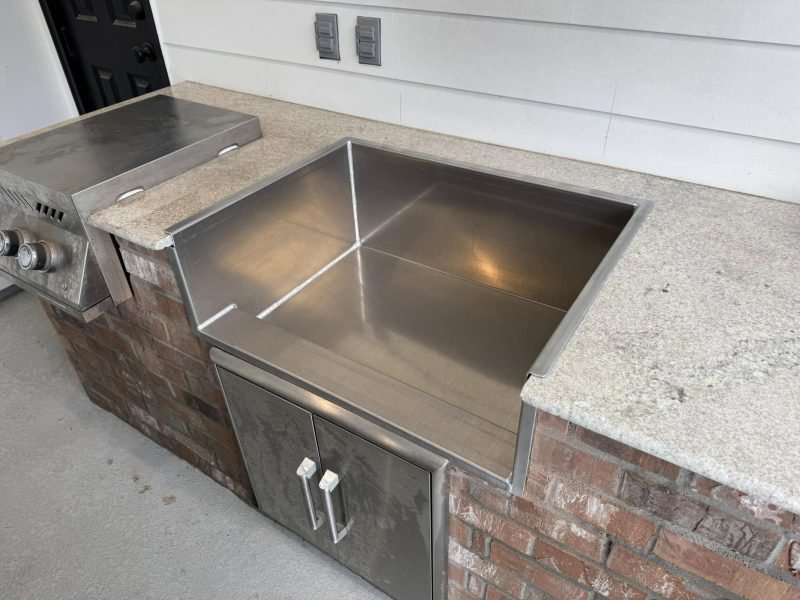
- Outdoor kitchens: stainless for the grill surround, sink, countertop and anything that touches food, heat or grease. 316 if the kitchen is near the water. The frame underneath can be aluminum or stainless; a bare carbon steel frame is the usual cause of rust streaks. See the outdoor kitchens and range hoods page.
- Railings and ramps: aluminum, usually powder coated for homes and left mill finish or brushed for commercial work. It is light to install on a deck or walkway and never rusts onto the decking. Stainless railings are chosen for the look on high-end work and cost more.
- Toolboxes and truck boxes: aluminum, almost always. Weight is the whole point on a truck, diamond plate is easy to keep clean, and bare aluminum needs nothing. Stainless boxes exist for washdown and food service trucks.
- Tanks: aluminum for fuel transfer, water and hydraulic reservoirs on trucks and equipment where weight matters. Stainless for chemical, food grade and anything that must be cleaned to a standard. The toolboxes and tanks page shows both kinds of work.
- Enclosures and cabinets: aluminum for electrical and storage enclosures outdoors; it keeps weight down on a pole or a skid and does not rust around door seals. Stainless for enclosures that get hosed down, see chemicals or sit in a plant where carbon steel and aluminum both suffer. See enclosures and cabinets.
- Gates and fences: aluminum for lightweight gates and coastal work; ornamental iron with a good coating for the traditional look, which is a separate choice covered on the gates and fences page.
Maintenance and what to tell the shop
Neither material is maintenance free, but both are low maintenance. Aluminum wants a fresh water rinse a few times a year near the coast and a look at any fasteners where it meets steel. Powder coated aluminum should be washed with mild soap and touched up where it chips. Stainless wants rinsing, a wipe with a soft cloth along the grain, and no steel wool, steel brushes or chlorine bleach, all of which leave rust. A yearly check of crevices and gaskets keeps stainless bright for decades.
When you ask for a quote, three details let a fabricator choose well:
- Where it lives: inland, near the coast, on the water, under cover or in full weather.
- What it touches: food, fuel, chemicals, salt water, a steel structure, concrete, treated lumber.
- What it has to look like: utility finish, powder coat color, brushed or polished.
With those answered, the choice between aluminum and stainless usually makes itself, and the alloy, grade, fasteners and finish follow from it. Send your drawing or photos through the quote form and H&L Fabrication in Lafayette will come back with questions or a price.