

Miscellaneous metals for commercial projects
Every commercial building needs metal parts that are not part of the structural steel package: handrails, guardrails, ramps, gates, bollards, brackets, embeds, ladders, canopy frames, equipment supports and the hundred small pieces that show up on the architectural drawings and in the field. In the trade these are called miscellaneous metals, and they are what H&L Fabrication builds for commercial construction.
The shop is in Lafayette, Louisiana, and commercial construction is one of the industries it serves most, along with oil and gas and residential work. Parts are fabricated in the shop and picked up or installed, and a mobile welder can be on site when the schedule calls for field welding. The shop works from the contractor's drawings, in carbon steel, aluminum or stainless steel.
Railings, guardrails and ramp handrails
Railings are the most visible metalwork on most commercial jobs and the ones inspectors look at hardest. The shop builds them to the drawings and to the dimensions taken in the field, because framed openings and poured slabs rarely match the plan to the inch.
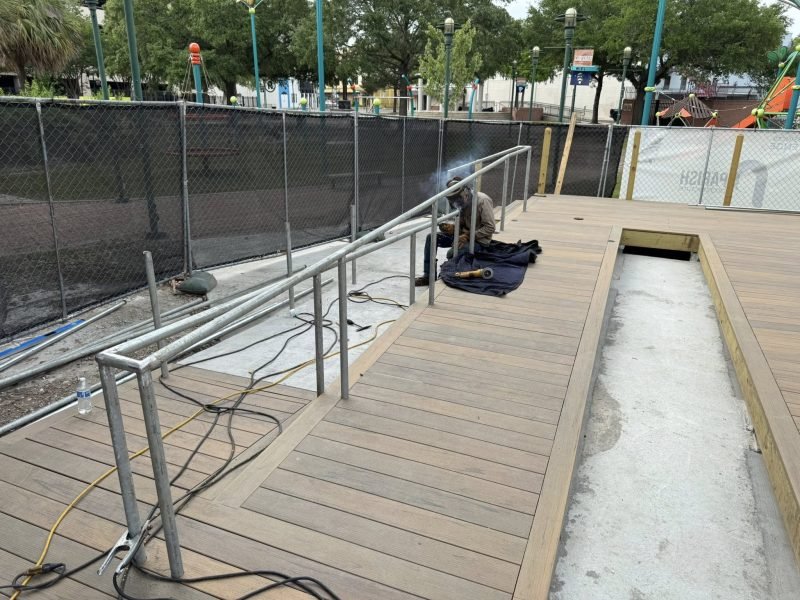
- Ramp handrails. Continuous handrails on both sides of a ramp, at the mounting height and with the extensions, returns and gripping surface the accessibility standards describe, built to the ramp as it was actually poured or framed. Aluminum is common because it needs no paint; steel is used where the drawings call for it.
- Stair rails and guardrails. Pipe, tube or picket rails for interior and exterior stairs, landings, mezzanines and balconies, with posts set to the stair as built.
- Walkway and deck rails. Aluminum rail on decked walkways, boardwalks and elevated paths, like the decked walkway rail shown in the portfolio.
- Wall-mounted handrails. Returns, brackets and wall plates that hit blocking or structure.
Rails are shop fabricated in sections that fit through doors and onto a truck, with field splices where needed, and either handed over for the contractor's crew or installed by the shop. See railings and ramps for examples.
Mesh security gates and enclosures
Commercial properties need to keep people and equipment in or out. The shop builds welded mesh security gates, cages and enclosures from tube frames and welded wire or expanded metal, with heavy hinges, drop rods, lock boxes and hasps. Typical uses include dumpster enclosures, mechanical and electrical yard cages, rooftop equipment screens, loading dock gates, storage cages inside warehouses, and lockable enclosures for generators, compressors and gas bottles.
Frames are built square so gates swing true and latch without lifting. Steel enclosures are coated for outdoor use, with galvanizing or powder coating done by a coating shop; aluminum is used where weight or corrosion matters. Examples are under enclosures and cabinets and gates and fences.
Brackets, embeds and canopy frames
Behind the finishes on a commercial building are the brackets and embeds that hold things up. The shop fabricates:
- Embed plates. Steel plates with welded studs or anchors cast into concrete so steel can be welded or bolted to the structure later. Cut on the CNC plasma table to the drawing and ready ahead of the pour.
- Brackets and supports. Equipment supports, sign brackets, awning brackets, pipe and duct supports, ledger angles, lintels and shelf angles.
- Canopy and awning frames. Welded tube and channel frames for entrance canopies, walkway covers and awnings, built to the architectural drawings and ready for the roofing or fabric.
- Bollards, ladders and platforms. Pipe bollards, fixed ladders, roof access platforms and equipment curbs.
Plate parts come straight from the drawing file to the plasma table, and bent parts are formed on the 14 ft, 200 ton press brake, so hole patterns and bends match the drawing.
On-site welding during construction
A fabrication shop that can also weld on site saves a contractor time and coordination. Through mobile welding, H&L Fabrication sends a welder and equipment to the job for:
- Welding railing posts and brackets to embeds and structure.
- Field splices on long rail runs and canopy frames.
- Fixes when something in the field does not match the drawing: a post that lands on a joint, an opening that is an inch wide of the plan, a bracket that needs to move.
- Welding clips, angles and supports for other trades.
- Repairs to damaged metalwork before turnover.
Field welding on steel is usually done with stick or flux cored wire, which work in wind and outdoor conditions. Aluminum and stainless can be welded on site in a sheltered spot. The welder follows the site's safety rules and hot work procedures.
Working with general contractors
Commercial work runs on schedules and paperwork, and the shop is used to both. When a GC or a subcontractor sends a package, the shop reviews the drawings and specifications, asks its questions in one list, and prices the scope. From there the job runs in a way that fits the construction schedule:
- Field dimensions are taken after the slab, stairs or framing are in place, before fabrication of anything that has to fit them.
- Embeds and anything that goes in before a pour are fabricated first.
- Rails, gates and frames are fabricated in the shop while the site is not ready for them, then handed over or installed when it is.
- Changes are confirmed in writing before they are built.
- The shop communicates by phone and email, and one person is responsible for the job from quote to finished part.
The shop also works directly with architects, engineers, property owners and facility managers on smaller projects and repairs.
Drawings and submittals, in plain words
On a commercial job the metalwork usually has to be drawn up and approved before it is built. The words can be confusing, so here they are plainly.
- Contract drawings are the architect's and engineer's plans. They show where the railings, gates and brackets go and what they have to meet.
- Shop drawings are the fabricator's drawings of exactly what will be built: dimensions, materials, member sizes, welds, finish and how it attaches. The shop prepares shop drawings from the contract drawings and field dimensions when the project calls for them.
- Submittals are the package of shop drawings, product data and samples sent to the GC and on to the architect for review. The reviewer marks them approved, approved as noted or revise and resubmit. Nothing is fabricated until the submittal is approved, so getting it in early keeps the schedule.
- Field dimensions are measurements taken on site after the surrounding construction is in, and they override the plan dimensions.
Send the contract drawings and the specification section for miscellaneous metals, and say whether submittals are required and when. The quote guide covers what else helps.
Materials and finishes for commercial work
Carbon steel is used for most structural brackets, embeds, bollards, canopy frames and steel railings, finished as the specification calls for: primer and paint, or powder coat and hot-dip galvanizing through a coating shop. Aluminum is the usual choice for ramp handrails, walkway rails and anything exterior that should never need paint, and it is light enough to install by hand. Stainless appears on food service, healthcare and high-end architectural work. The shop welds all three and will suggest a material when the drawing leaves the choice open, with South Louisiana humidity in mind.
H&L Fabrication is in Lafayette, Louisiana and works on commercial projects across Acadiana. Call (337) 207-9506, email hlfabrication@outlook.com, or request a quote with your drawings and the team will come back with questions or a price.