

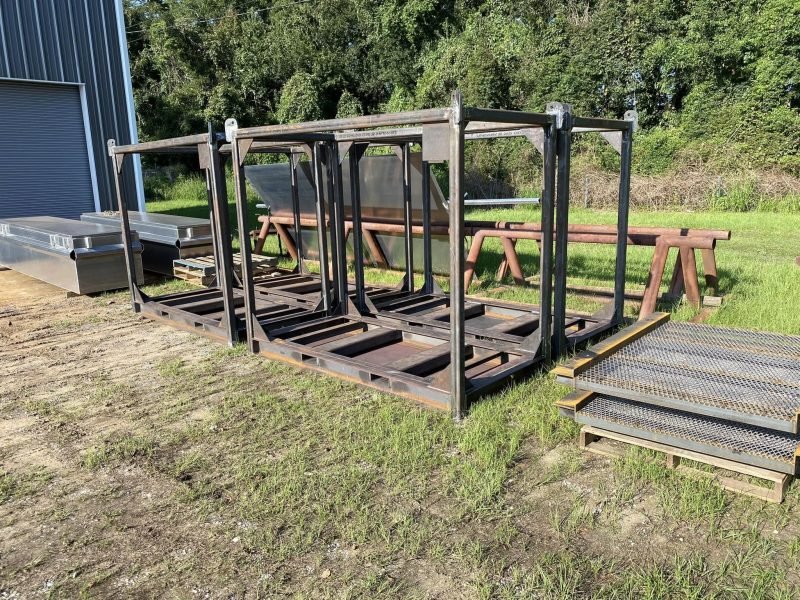
Carbon steel, the workhorse of the shop
Carbon steel, usually called mild steel when the carbon content is low, is the metal most of the world is built from. It is strong, stiff, inexpensive, easy to cut and form, and it welds with every common process. It comes as plate, sheet, flat bar, angle, channel, square and rectangular tube, round tube, pipe and wide flange beam, so almost any shape can be built from stock without special ordering.
Its one weakness is that it rusts. In South Louisiana, where the air is damp most of the year, bare steel starts to turn orange within days. That is why coating is part of every carbon steel job and why this page spends as much time on finishing as on welding.
H&L Fabrication is a custom shop in Lafayette, Louisiana. Carbon steel is the bulk of the work that goes through full-service welding, custom metal fabrication and mobile welding.
MIG, stick and TIG on mild steel
Carbon steel welds with all three arc processes, and the shop picks based on thickness, position, location and how the weld needs to look.
MIG
MIG feeds solid or flux cored wire through a gun with a continuous arc. It is fast, it handles everything from thin sheet to heavy plate, and it leaves little cleanup. In the shop, MIG does most of the production welding on frames, skids, enclosures, gates and tables. Flux cored wire runs well outdoors where shielding gas would blow away.
Stick
Stick, also called SMAW, uses a flux-coated rod. The equipment is simple and the process tolerates wind, rust, mill scale and dirty field conditions better than anything else. It is the first choice for mobile welding on structural steel, pipe supports, heavy repairs and anything outdoors. Stick deposits strong, deep welds on thick material and is the standard for field structural work.
TIG
TIG on carbon steel is for precise, clean welds on thin material, visible joints and places where spatter is not acceptable. It is slower and used where the result justifies it: thin sheet enclosures, decorative gate details and small brackets.
The MIG vs TIG vs stick guide goes through the trade-offs in more depth.
Structural shapes and plate
Most carbon steel fabrication starts with structural shapes: wide flange beam, channel, angle, square and rectangular tube, and plate. The shop cuts them to length, copes and notches them to fit each other, and welds them into assemblies.
Plate parts come off the CNC plasma table, which cuts base plates, gussets, brackets, flanges and cutouts straight from a drawing file. Plasma leaves a thin hardened edge and a little dross that is ground off before welding or forming. Bent plate parts such as channels, pans, brackets and enclosure panels are formed on the 14 ft, 200 ton press brake, which lets one bent piece replace several welded ones and keeps parts straighter with less heat.
Thickness drives the process. Thin sheet is welded with low heat and short welds to stop warping. Plate over about half an inch often gets beveled edges and multiple passes so the weld reaches full depth. Heavy sections may be preheated so the weld cools slowly and does not crack.
What the shop builds in carbon steel
- Skids and equipment frames. Welded channel and tube bases for pumps, valves, manifolds, compressors and instruments, with lifting lugs, drip pans and mounting plates. See skids and frames.
- Gates and fences. Ornamental iron fences, arched gates, driveway gates and security gates, built from tube, pickets and plate, hung to swing true. See gates and fences.
- Enclosures. Welded steel boxes, mesh security enclosures and equipment cages with doors, hinges and locks. See enclosures and cabinets.
- Platforms and walkways. Grating platforms, stair stringers, walkway frames and handrail in angle, channel and pipe.
- Work tables and stands. Flat, heavy, square tables for shops and plants, with plate tops and tube legs.
- Brackets, supports and fixtures. Pipe supports, plate brackets, embeds and one-off fixtures from a drawing or a sketch.
Repair welding
Carbon steel is the easiest metal to repair, which is why so much equipment is made from it. Cracked trailer frames, broken equipment mounts, worn bucket edges, bent gate frames, rusted-through fence posts and failed brackets are everyday repairs in the shop and in the field.
A good repair starts with finding out why the part failed. A crack in a frame gets ground out to its full depth and welded from the root, with a doubler or gusset added where the original design was too light. A rusted section gets cut out and replaced with new steel rather than welded over. Worn edges get built up or faced with new plate. The aim is a repair that outlasts the original, not one that holds until the next load.
Repairs on machinery, structures and equipment that cannot be moved are done through mobile welding, with stick or flux cored wire that works outdoors. The shop vs mobile welding guide helps you decide which is right for your repair.
Prep and fit-up
Steel comes from the mill with a dark grey mill scale on it, and from the yard with rust and oil. Welding through scale and rust is possible with stick and some flux cored wires, but it makes weaker, more porous welds and ruins MIG and TIG welds. On anything that matters, the joint area is ground to bright metal before welding.
Fit-up is how well the parts meet before the arc is struck. Gaps that are too wide have to be filled with weld metal, which adds heat, distortion and cost. Edges that are too tight on thick plate keep the weld from penetrating. Parts are cut accurately, thick edges beveled, the assembly tacked together on a flat table and checked square and plumb, and only then are the welds run. Weld sequence matters as much as the welds themselves. Welding one side of a frame completely before the other pulls the frame out of square. Alternating sides and skipping along the seam keeps the heat balanced and the part straight.
Coatings in plain words
Every carbon steel part leaves the shop with a plan for keeping rust off it. The options, from simplest to most durable:
- Primer. A first coat that bonds to clean steel and gives paint something to grip. Red oxide and grey shop primers protect a part for a while in storage, but primer alone is not a finish and will chalk and fail outdoors.
- Paint. A top coat over primer, brushed, rolled or sprayed. Industrial enamels and urethanes hold up well when the steel is properly cleaned first. Paint can be touched up in the field, which is its main advantage.
- Powder coat. Dry powder sprayed onto the part with an electrostatic charge, then baked until it flows into a hard, even skin. Powder coat is tougher than paint, has no runs or drips, and comes in almost any color. It cannot be touched up in the field, so chips need to be sealed with a matching paint.
- Hot-dip galvanizing. The part is dipped in molten zinc, which bonds to the steel and coats every surface, inside and out. Zinc protects steel even where it is scratched, because the zinc corrodes first. Galvanizing is the longest lasting option for fences, gates, platforms and anything that lives outdoors in a wet climate. Parts have to be designed with vent and drain holes so the zinc can flow through and out.
The shop builds parts to suit the coating they will get. Galvanized assemblies get vent holes. Powder coated parts get welds ground smooth where the finish will show.
Rust prevention in South Louisiana humidity
Humidity here sits high for most of the year, and the Gulf is close enough that salt rides in on the air. Steel that would last years bare in a dry climate rusts in weeks in Acadiana. A few things make the difference between a part that lasts and one that streaks orange by the second summer.
- Blast or grind to clean metal before coating. Coatings fail from underneath when they are put on over scale, rust or oil.
- Seal every seam. Water that gets into an uncoated joint between two pieces of steel will rust them apart from the inside. Welds are run continuously where water can enter, or the joint is caulked after coating.
- Cap open tube ends. A tube open at the top fills with rain and rusts from the inside out.
- Keep steel off the ground. Posts and legs set in concrete or on plates with a drip gap last far longer than steel sitting in standing water.
- Choose the coating to match the exposure. Paint under a roof, powder coat on a patio, galvanizing in the open.
Where rust is simply not acceptable, the shop can build the same part in aluminum or stainless steel instead, and will tell you honestly when that is the better buy.
What to send for a carbon steel quote
Send a drawing, a sketch with dimensions, or photos of what you need built or fixed. Say what load the part has to carry, where it will live and what coating you want. For repairs, photos of the break and of the whole item tell the shop most of what it needs. For plate parts, a dimensioned drawing is all the plasma table needs. The guide on what to send for a fabrication quote has the full list.
H&L Fabrication is in Lafayette, Louisiana, with mobile welding to Crowley, Abbeville, New Iberia and the surrounding Acadiana region. Call (337) 207-9506, email hlfabrication@outlook.com, or request a quote for your carbon steel project.