


What we build
A cabinet keeps things organized; an enclosure keeps things protected. The shop builds both, and the line between them is mostly about what goes inside and where it lives.
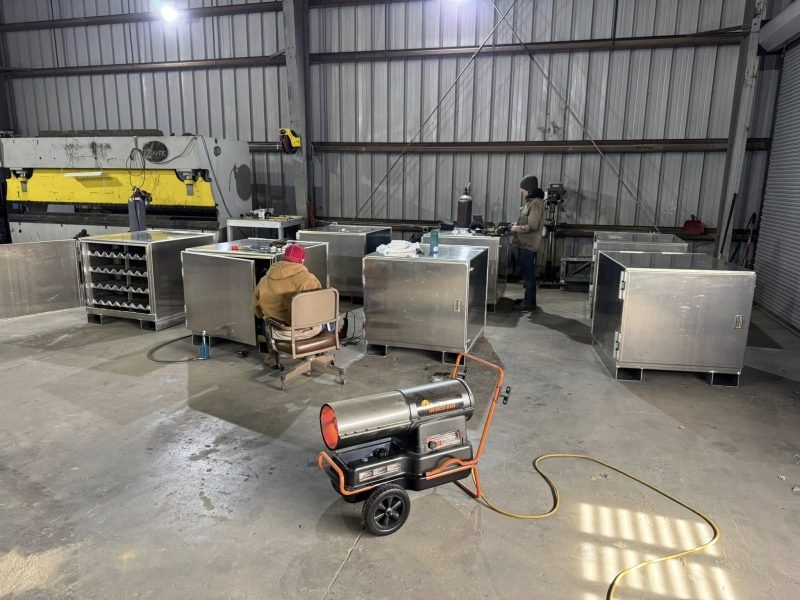
- Aluminum double door cabinets with adjustable or fixed shelves for shops, trucks and job sites
- Aluminum lockers and storage units with angled shelves for parts, bottles and hoses
- Cabinets with X-braced doors that stay square under daily use
- Welded steel equipment enclosures with hinged doors for pumps, controls, compressors and generators, built to ship on a trailer
- Welded mesh security cages, tool cribs and partition walls with gates
- Mesh security gates for yards, storage rooms and utility areas
Cabinets are formed from sheet on the press brake so the corners are bends rather than welded seams wherever possible, which is stronger and cleaner. Door frames, enclosure skeletons and cage frames are welded from tube and angle, with sheet or mesh skinned over them.
Sheet thickness in plain words
The thickness of the sheet sets how stiff the cabinet is, how much it weighs and what it costs. Thinner sheet is lighter and cheaper but will oil-can, meaning a large flat panel pops in and out when pressed. Thicker sheet stays flat and takes a hit, but it adds weight fast, which matters on a truck and on a door that someone has to swing.
The usual approach is to pick the thickness by the size of the largest flat panel and by how the cabinet will be treated. A small tool cabinet in a shop can use a lighter gauge. A tall double door cabinet riding on a service truck wants a heavier gauge, or a lighter gauge with bends and ribs formed into the panels to stiffen them. Enclosures that sit outdoors and get bumped by equipment use heavier steel plate and sheet, and the frame under the skin does most of the work.
We will recommend a thickness once we know the size, the material and where the cabinet lives. If you have a cabinet you like, telling us its gauge is a quick way to get the same feel.

Doors, hinges and latches
Doors are where cabinets succeed or fail, because they are the only moving part. A door needs to stay square, close flat and latch without being slammed.
For square, a door panel gets a formed flange around its edge and, on larger doors, a diagonal brace across the back. The X-braced doors in our aluminum cabinets are built that way for a reason: a tall, wide door with nothing but a flat sheet will rack and start catching on the frame within a year. The X brace turns the door into a frame that holds its shape.
For hinges, the choice is between a continuous piano hinge along the full height, which spreads the load and keeps the door from drooping, and individual weld-on or bolt-on hinges, which are heavier duty and easier to replace. Lift-off hinges let a door come off for access. Stainless hinges go on anything that lives outdoors.
For latches, cabinets get slam latches, paddle latches or compression latches, with a padlock hasp or a keyed lock when security matters. Double door cabinets usually have one door that latches to the frame top and bottom and a second door that latches to the first. Enclosures with heavy doors get a three-point latch so the door seals along its whole height.
Shelves and interiors
Shelves are built to the load. A light parts shelf can be a formed sheet with a lip; a shelf for batteries, oil or tooling gets a heavier gauge and a formed edge on all four sides. Fixed shelves are welded in and add stiffness to the whole cabinet. Adjustable shelves ride on welded angle or on slotted uprights.
Angled shelves are a frequent request for aluminum cabinets that hold bottles, cans, hoses or anything round. The shelf tilts back a few degrees with a lip at the front so items settle against the rear wall and stay put when the truck moves or the door opens. Dividers, hooks, drawer slides and hanging rails can all be welded in while the cabinet is being built, which is much easier than adding them later.
Ventilation and weather sealing
Equipment makes heat, and sealed boxes trap it. An enclosure for a pump, a compressor or a control panel needs air in and air out. That can mean louvered panels formed on the press brake, screened openings, a hooded vent that keeps rain out while letting air through, or a cutout for a fan the electrical contractor installs. We place vents low on one side and high on the other so air moves across the equipment on its own.
Weather sealing is the opposite problem: keeping water out of the parts of the enclosure that need to stay dry. Doors get a formed drip edge along the top and a rubber bulb seal in the frame. Roofs are sloped or crowned so water runs off instead of pooling. Seams on the outside are welded continuous and ground, and the bottom of the enclosure has drain holes so any water that does get in can leave. Fully sealed is rarely the goal; letting water out is as important as keeping it out.
Louisiana humidity means the inside of an enclosure will be damp no matter what, so controls and electrical gear inside are usually in their own rated box within the enclosure. We build the cutouts and mounting plates for those.
Aluminum or steel
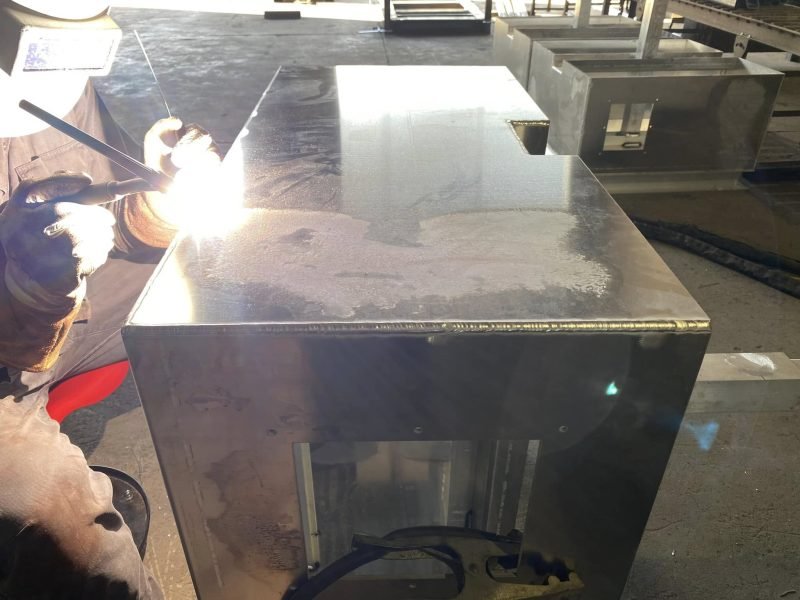
Aluminum is the first choice for cabinets and lockers that live on trucks, in boats or outdoors. It does not rust, so it can be left bare or lightly brushed, and the weight savings matter on a vehicle. It is welded with AC TIG, which the shop runs regularly for toolboxes and tanks as well. The tradeoff is that aluminum sheet dents more easily than steel of the same thickness and costs more per pound.
Steel is the choice for enclosures and cages that take abuse or carry heavy equipment. It is stronger, cheaper per pound and easy to weld with MIG, and it holds up to a forklift bump. Steel needs a coating in our climate, so steel enclosures are primed and painted or powder coated, and galvanized mesh is used where a cage will live outdoors. Stainless is used when a cabinet has to look clean and resist corrosion at the same time, such as in a food area or a wash bay. The aluminum and carbon steel pages have more on each.
Security cages and mesh gates
Welded wire mesh is the material for tool cribs, server and parts cages, storage partitions and yard gates where you need to see in and keep people out. The mesh is welded into a tube or angle frame panel by panel, and the panels bolt or weld together into walls with a swinging or sliding gate. Mesh size is chosen for what it has to stop: a tight mesh for small parts, a wider one for airflow and visibility. Gates get a heavy frame, padlock hasps or a keyed lock, and hinges that cannot be unpinned from the outside.
What to send for a cabinet or enclosure quote
Send the outside dimensions you have room for, or the inside dimensions of what has to fit, along with where the cabinet or enclosure will live and whether it will be bolted down, mounted on a truck or shipped on a trailer. Photos of the space or of the equipment help. If you want shelves, tell us what goes on them. Our guide to what to send for a quote has the full list, and finished cabinets and enclosures are in the project gallery.
Need a cabinet, locker, enclosure or security cage built to size? Request a quote or call (337) 207-9506.
