

A fabrication shop built around oil and gas work
H&L Fabrication is a custom metal fabrication and welding shop in Lafayette, Louisiana. The business was established in 2024 by a team with 15 years of experience in the fabrication business, and the oil and gas industry is the industry it serves most. That means the shop is used to working from engineered drawings, building to a specification, matching bolt patterns to equipment that already exists, and getting parts to a facility or a yard when they are needed.
The work breaks into two parts. Shop fabrication covers skids, stands, platforms, enclosures, supports and plate parts built in Lafayette. Mobile welding covers repairs, modifications and installation welding done at the customer's facility, yard or site. Most oil and gas customers end up using both.
Skids, manifold stands and valve stands
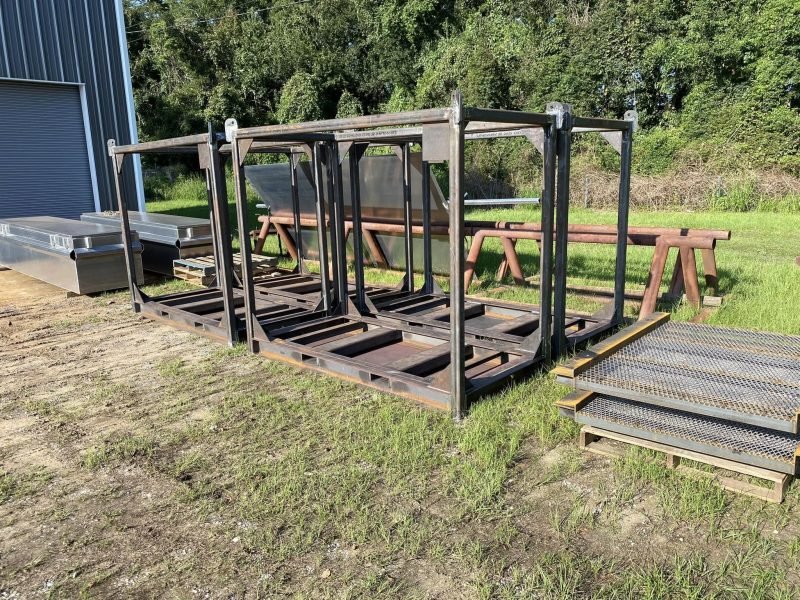
A skid is a welded steel frame that carries equipment so it can be built and tested in the shop, then lifted, trucked and set as one unit. Skids are the backbone of oil and gas fabrication because they move the work from a field, where every hour is expensive, into a shop where it is controlled.
- Valve and manifold skids. Channel or tube bases with saddles, mounting plates and pipe supports that hold a manifold or a set of valves at the right height and spacing. Built so the piping lands on the supports without forcing.
- Pump and compressor bases. Heavier frames with machined or shimmed mounting pads, drip pans and lifting lugs placed for a balanced pick.
- Instrument skids. Smaller frames and stands for meters, transmitters, sample systems and control panels, often with a grating deck and a handrail.
- Valve stands and pipe stands. Simple welded stands that support a valve or a run of pipe at grade, with base plates for anchoring to concrete.
Skids are built square and flat on a level table, with cross members where the equipment loads land. Lifting lugs are sized and placed for the weight, and the frame is checked for twist before it goes out the door. See examples under skids and frames.
Grating platforms, walkways and access
Equipment needs to be reached, and that means platforms, stairs, ladders and walkways. The shop builds platform frames from angle, channel and tube, fits bar grating or checker plate decks, and adds handrail, toe plate and stair stringers. Frames are built to the drawing and to the openings in the equipment they surround, with bolted splices so sections fit through doors and onto a truck.
Walkway frames and crossovers are built the same way, with grating clips or welded grating as specified. Handrail is welded pipe or tube with posts on base plates or side-mounted brackets. Everything is built to the customer's drawing or to the dimensions taken in the field, and coated to suit the site.
Enclosures, cages and guards
Welded steel enclosures protect equipment and people. The shop builds equipment enclosures, mesh security cages, valve and instrument boxes, chemical pump enclosures, guards for belts and couplings, and lockable cabinets, from a drawing or a field measurement. Doors are hung on heavy hinges with weld-on hasps or latches, and panels are formed on the press brake so corners are bent rather than welded wherever that makes a cleaner, stronger box. Louvers, cutouts and penetrations are cut on the plasma table. Examples are under enclosures and cabinets.
Pipe supports, brackets and plasma cut plate
Much of the small, constant work in oil and gas is supports and plate. Pipe shoes, saddles, trunnions, anchor brackets, hangers, dummy legs, base plates, gussets, shims, flanges, blind plates and reinforcing pads are everyday parts in the shop.
Plate parts are cut on the CNC plasma table from the drawing. A full set of plate parts for a skid or a run of supports can be nested on a sheet, cut in one pass and ready for fit-up with hole patterns already in place. The table cuts carbon steel, stainless and aluminum. For bent brackets and channels, the 14 ft, 200 ton press brake forms plate accurately so a bent part replaces a welded one. Read how plasma cutting works in the plasma cutting guide.
Repairs and mobile welding at facilities
Not everything can be brought to the shop. Mobile welding brings the welder to the facility, the yard or the lease for repairs, modifications and installation work. Typical calls include cracked skid frames, broken pipe supports, damaged handrail and grating, worn equipment mounts, cutting and welding during a tie-in, adding brackets and supports to existing structures, and emergency repairs that stop a shutdown from running longer than it has to.
Stick welding and flux cored MIG work outdoors where wind would blow shielding gas away, so most field work runs on those processes. The shop welds carbon steel, aluminum and stainless on site. The mobile welding service area covers Lafayette, Crowley, Abbeville, New Iberia and the surrounding Acadiana region. The customer's site rules, permits and safety requirements are followed as a matter of course, and hot work is done when and where the facility allows it. The shop vs mobile welding guide explains when each makes sense.
Materials for oil and gas work
Most skids, platforms, supports and enclosures are carbon steel, coated with primer and paint, powder coat or hot-dip galvanizing to suit the site. Where weight matters, such as removable guards, walkway sections, cabinets and toolboxes on trucks and boats, aluminum is the usual choice. Stainless steel goes where chemicals, salt or sanitation call for it: sample system brackets, chemical pump enclosures, instrument stands in corrosive areas and marine work. The shop welds all three with MIG, TIG and stick and will recommend a material if the drawing leaves it open.
How a job runs, from drawing to finished part
- Send the drawing. A PDF or CAD drawing, a marked-up sketch, or photos and field dimensions. Say what the part does, what it bolts to and where it is going.
- Review and questions. The shop reads the drawing, flags anything unclear, suggests changes that make the part easier to build or coat without changing how it works, and confirms material and finish.
- Quote. A written quote for the scope agreed on. Changes after that are handled as changes, in writing, so there are no surprises.
- Cutting and forming. Plate parts are cut on the plasma table, bent parts are formed on the press brake, and structural shapes are cut, coped and beveled.
- Fit-up and welding. Parts are tacked on a flat table, checked for square, level and bolt pattern, then welded in a sequence that keeps the assembly straight.
- Checking. Dimensions are checked against the drawing before the part leaves the shop, and the customer is welcome to inspect in the shop before coating.
- Finishing. Prime and paint, powder coat or galvanizing as specified, with vent holes and masking planned in at the design stage.
- Delivery. Pick-up at the shop in Lafayette, or delivery arranged when the quote is written. Field welding for installation is available through mobile welding.
H&L Fabrication is a custom shop and takes on jobs of any size, from a single bracket to a full skid package. Call (337) 207-9506, email hlfabrication@outlook.com, or request a quote with your drawing and the team will come back with questions or a price.