

What we build
Outdoor kitchens around Acadiana are usually brick or block islands built by a mason, with the metal parts added afterward. That is where we come in. We build the stainless pieces that set into the masonry and the hoods that hang above a cooktop, indoors or out.
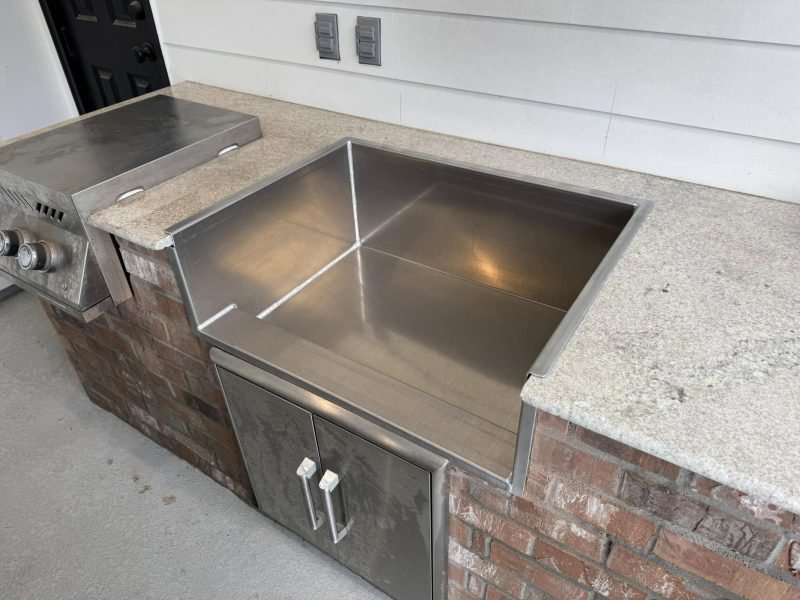
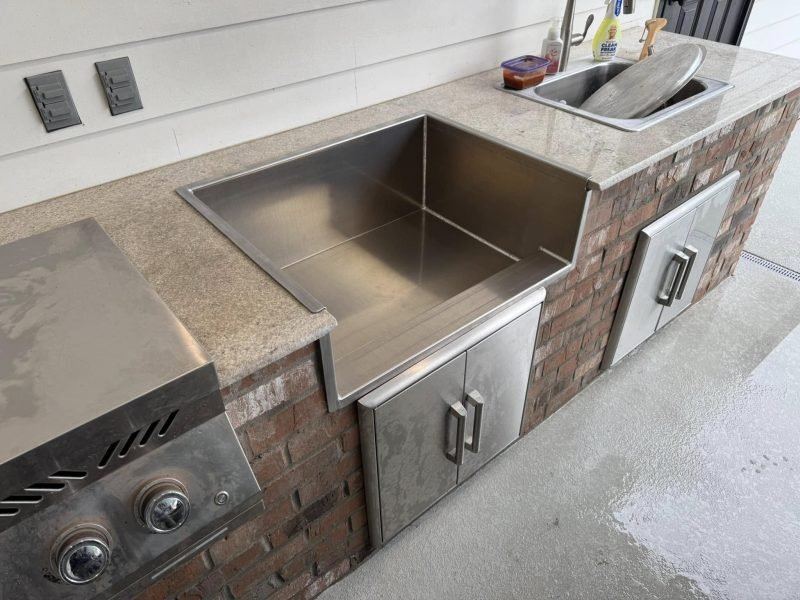
- Stainless steel sinks welded to fit a countertop cutout, with or without a drainboard
- Stainless access doors and door frames set into the face of a brick island
- Stainless grill surrounds and trim that frame a drop-in grill and close the gap to the brick
- Stainless countertops, shelves and splash panels for a grill station
- Stainless wall-mounted range hoods for indoor and covered outdoor kitchens
- Black steel island range hoods that hang from a vaulted ceiling over a cooktop
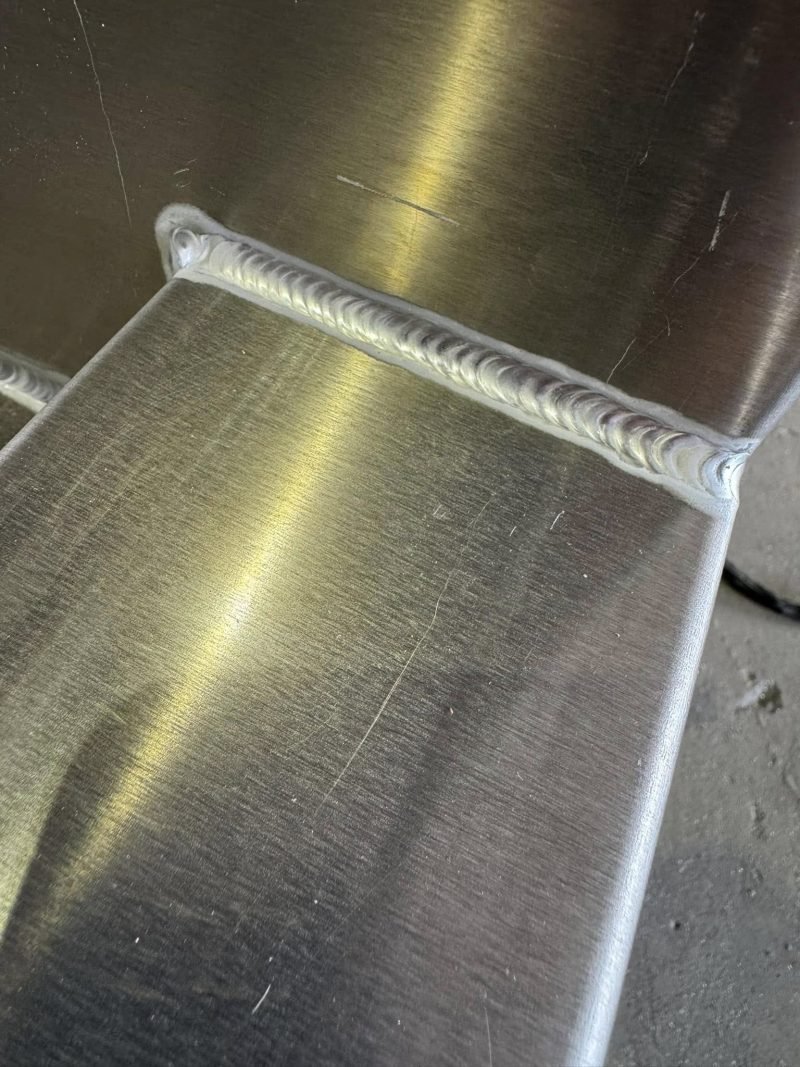
All of it is cut, formed on the press brake and welded in the shop. Hoods and sinks are built as one welded piece rather than screwed-together panels, which is what keeps the seams from collecting grease and water.
Measuring the opening
Stainless parts for a brick island have to fit an opening that already exists, so measurement is most of the job. Brick openings are rarely perfectly square, and two sides of the same island can differ by a quarter inch or more.
For an access door, we measure the rough opening at the top, middle and bottom, and at both sides, and we check the corners for square. The door frame is built to the smallest dimension with a flange wide enough to cover the ragged edge of the brick. For a sink, we need the cutout size in the countertop, the depth available under the counter and the location of the drain and water lines. For a grill surround, we need the grill maker's cutout drawing and the actual brick opening, because the two never quite agree.
If the island is not built yet, we can give the mason the dimensions to leave for each piece, which is the easiest route of all. If it is already built, send photos and measurements or ask us to measure on site.
Stainless grades in general terms
Stainless steel comes in families, and two show up in kitchen work. The common kitchen grade is the one used for most sinks, counters and hoods; it resists rust well, welds cleanly and polishes to a bright finish. A second grade adds an alloying element that improves resistance to salt and chlorides, and it is the one to ask for in an outdoor kitchen near the coast, next to a saltwater pool or where salty cooking spills sit on the surface. It costs more and looks the same.
Stainless resists corrosion because of a thin protective layer that forms on its surface. Welding disturbs that layer, so the welds are cleaned and passivated or polished afterward to let it reform. Stainless that has been welded and left dirty will show tea-colored staining around the welds, which is the first thing we avoid. More on how we handle the material is on the stainless steel welding page.
Finishes
The finish on stainless is a choice, not a given. A brushed finish, with fine lines running one direction, is the standard for sinks, counters and hoods. It hides fingerprints and light scratches, and new scratches blend in if they run with the grain. A polished or mirror finish is brighter and shows every mark; it suits trim and small accents more than a working surface. Mill finish, which is how the sheet arrives, is duller and fine for parts that will not be seen.
Black steel hoods are a different animal. They are built from carbon steel, then cleaned and finished with a high-temperature paint or sent out for powder coating. A matte black island hood under a vaulted ceiling is a look many homeowners ask for, and the carbon steel lets us build it heavier and with sharper lines than thin stainless sheet. Indoors, with the coating intact, carbon steel holds up well. Outdoors in our humidity, we steer hoods toward stainless.
Built to be cleaned
A kitchen part that cannot be wiped down will not stay clean, so the details are built around the sponge. Inside corners on sinks and hood liners get a radius rather than a sharp crease, so grease and water do not pack into the corner. Seams are welded continuous and ground flush, with no open lap joints for water to wick into. Edges are hemmed or rolled so there is nothing sharp to catch a rag or a hand. Grease trays and filter frames in a hood are removable so they can go in the sink.
On outdoor sinks, the drain is set at the low point of a gently sloped bottom so the basin empties fully, which matters when the sink sits unused for weeks and the water in it would otherwise stagnate.
Hood sizing in plain words
A range hood has two jobs: catch what rises off the cooktop and carry it outside. The hood body does the catching, the blower and ductwork do the carrying.
The hood follows the cooktop. It should be at least as wide as the cooking surface, and on an island, where air can come at it from every side, wider is better. The depth front to back should cover the burners. The height above the cooktop is set by the appliance maker and the local code, and we build the hood and its mounting to land at that height.
The blower is a separate decision. The mechanical contractor or HVAC installer sizes the blower and the duct based on the cooktop's heat output, the duct run and the house's makeup air needs. We build the hood body with the opening and the mounting the blower needs, whether it is an insert that sets inside the hood or a remote blower on the roof. Tell us which blower is going in, and we will build around it. If no one has picked one yet, we will give you the dimensions to pass to your HVAC installer.
Island hoods that hang from a vaulted ceiling also need a chimney or a mounting frame that reaches the ceiling joists and carries the hood's weight. We build that frame as part of the hood.
Humidity and outdoor life
An outdoor kitchen in Lafayette sits in damp air most of the year. Stainless handles that well if it is the right grade and the welds are cleaned, and if it is rinsed now and then. Where things go wrong is in mixed metals: a plain steel screw through a stainless panel, or a carbon steel bracket touching a stainless door, will rust and stain the stainless around it. We use stainless fasteners and hardware on stainless parts and isolate anything that cannot be stainless.
Grease and salt left on a surface are the other enemy. A quick wash after a cook, especially after seafood, keeps the finish bright. Covered patios help, but a cover does not stop humidity, so the material choice still matters more than the roof.
What to send for a quote
To price a sink, door, grill surround or hood, send:
- Photos of the island, the cooktop or the wall where the hood will go
- The opening sizes, or the cooktop width for a hood
- The grill or blower make and model if one is already chosen
- Whether the piece is outdoors, under a cover or indoors
- The finish you want: brushed stainless, polished accents or black steel
See examples of stainless kitchen work and hoods in the project gallery, or read our guide to what to send for a quote. Planning an outdoor kitchen or a new range hood? Request a quote with your photos and measurements, or call (337) 207-9506.
